



Out of the BoxQ-Air Grinder
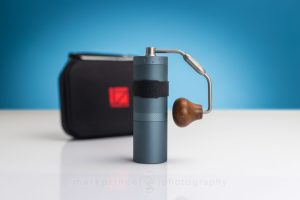
Unboxing the 1Zpresso Q‑Air gives you a compact package: the grinder itself weighs in under 365 g and measures 14.5 × 15 × 4.6 cm, roughly the size of a Red Bull soda can. It arrives with a silicone anti‑slip band (which you’ll need to remove to fit inside the AeroPress), the removable crank handle lid, and that’s about it; no brush or pouch, just simple and straightforward.
Sadly, 1Zpresso uses a lot of polystyrene to package this product, something we urge every manufacturer in the specialty coffee arena to get away from. They could easily create a cardboard cocoon to protect this grinder during transport.
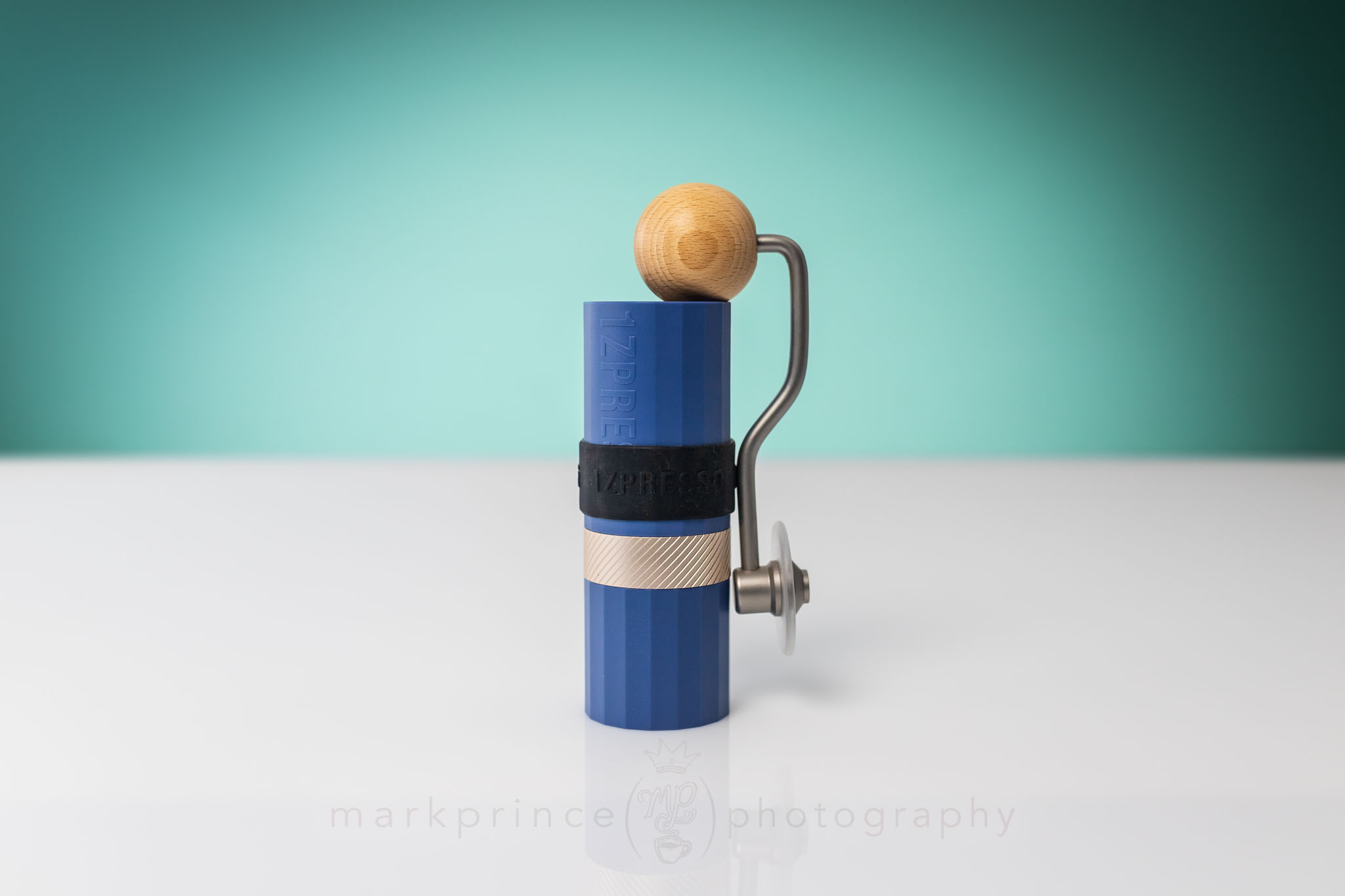
The Q-Air comes in four colour choices: Black, Blue, Grey and Purple, so you can pick one that suits your style. We went with the kind of steel blue model for this review.
At first touch, the plastic exterior of the Q‑Air feels light but well put together. While it lacks the all-metal heft of its Q2 sibling, the Q‑Air still houses the same internals. That means a 38 mm stainless steel heptagonal burrset, shared with the Q2 and original Q, and the same internal adjustment collar mechanism. The grinding core elements are steel and aluminum, so while your hand holds plastic, the force transfers through solid metal.
Disassembly is intuitive and tool-free. Just unscrew the hopper, unscrew the adjustment dial, and lift everything out – adjustment system, bottom burr and spring. One small trap to watch out for: the adjustment dial mount is reversible, though not by design. It’s possible to reassemble it with the zero point accidentally offset, and I have done that myself, ending up with the zero point at the 5 click mark. Another quirk is that the dial counts up as you turn finer, which runs opposite to most zero-down designs and takes a little mental reprogramming.
The adjustment system offers 30 clicks per full 360-degree rotation, each moving the burrs by roughly 25 microns (as claimed by 1Zpresso; we haven’t confirmed this granular detail as we don’t go that deep in Snapshot reviews, but others who have tested this confirm the click adjustment range is around 25 microns).
Also interesting to note: while the Q2’s dial markings might appear more extensive at a glance, the Q‑Air and Q2 share identical mechanisms underneath. This makes the Q‑Air just as repeatable and precise for grind settings within its target range as the more expensive grinder.
The handle is short, but it feels balanced and responsive. The ball shaped wooden knob rotates smoothly, and the textured plastic ridges along the body give a decent grip, even with slightly damp hands. Our test unit weighed in at 361g (367g with the included silicone grip), matching 1Zpresso’s spec sheet.
The build may not scream luxury, but it does feel deliberate. It’s designed for portability and function, not flexing on your Instagram brew rig (though to be honest, it looks pretty cool when stuffed in an AeroPress). And knowing it shares its internals with the Q2 gives some reassuring confidence that this budget grinder is cut from the same cloth, even if the suit is polyester instead of wool.
First impressions: the crank rotates smoothly, though not silky‑smooth: a mild gritty feel gives tactile feedback. The plastic housing invites a pinch of skepticism, as it lacks the ruggedness of X‑Ultra or K‑Ultra, but the build feels thought‑out for travel, not the shop.
Early trial runs with coarse and medium grind settings deliver a fast grind with minimal retention. An 18g dose takes about 30-40 seconds, handy for V60 or Aeropress. Visually, it’s simple, functional, perhaps a little plastic, but undeniably compact. Early verdict: At $70, this grinder spent all its money in the right places.

Support CoffeeGeek
If you enjoy and learn from this resource, please consider making a one time or recurring donation to help support our work and fund purchases for future reviews.
Using theQ-Air Grinder
Cranking away on the Q‑Air is straightforward and easy: pour your beans into the hopper (cheat-sheet: filling to the brim is around 19–20g, depending on the bean size), secure the lid, dial in your grind setting, attach the grinds bin, and go to work. For Aeropress, especially if you want a more condensed, extracted brew, try starting at one full rotation on the grind dial from zero; that should give you grinds in the 500 micron range. For V60, our starting point is around 50 clicks off zero, or 1.5 rotations on the grind dial.
| Brew Method | Micron Target | Dial Clicks (~) | Q‑Air Dial Starting Value |
|---|---|---|---|
| AeroPress | 500–600 µm | ~30–40 clicks | ~1.0.0 |
| V60 Pour‑Over | 650 µm | ~50–60 clicks | ~1.5.0 |
| Chemex | 800 µm | ~80+ clicks | ~2.5.0 |
| Siphon | 650 µm | ~60–70 clicks | ~1.7.0 |
I love grinders that pair up with the AeroPress, even if by accident. The Q‑Air easily slots into the standard Aeropress main plunger (something the Kingrinder P2 can’t do). In fact, you can kind of wedge it in with the silicone collar attached, as long as the collar is at the top of the grinder. The dose limit also suits the AeroPress, going up to 20g is about as much as you want to do in the 250ml (typical) max brew volume of the iconic plunger brewer.
For a full 18–20 gram V60 brew, grind time clocks in around 30 to 35 seconds, stretching to 40 if you’re dealing with a particularly light roast. The process feels efficient and easy to manage. That same timing generally applies for other pour-over methods like the Kalita Wave and Melitta-style cone brewers.
Cleaning the Q‑Air is straightforward: unscrew the adjustment dial until it (and the bottom burr) slide out, give the burrs a light brush (with your own brush, since they don’t include one), and reassemble without tools. If you’ve adjusted the dial, just be sure to double-check your zero point, as the orientation can flip if you’re not careful.
Because of the mix of materials in this grinder, static is an issue. You definitely want to use the RDT method if you can (spritzing the beans with a light mist of water) to keep things manageable. For me, this is an acceptable tradeoff considering all the good things about the grinder.
At the finer end of its range, the Q‑Air can reach espresso-adjacent grinds, but it’s not the grinder’s sweet spot. You’ll find a steep curve of diminishing returns in grind speed and comfort. Grinding at that level takes effort, and the results, while acceptable in a pinch, aren’t what most espresso drinkers would settle into long-term.
The Q‑Air offers impressive grind precision for its price. Each click moves the burrs by a company-claimed 25 microns, giving you repeatable settings as long as you note them down. The adjustment dial is internal, which means removing the grinds bin to make changes. It works, but it’s a step down in convenience compared to the external dials found on models like the X‑Ultra. That’s part of the trade-off in this entry-level category.
While it shares some design DNA with 1Zpresso’s higher-end grinders, the Q‑Air is not in the same class. The J‑Ultra, K‑Ultra, and X‑Ultra all feature better burr geometry, stronger construction, and much more refined adjustment mechanisms. Those models are not just the company’s flagships, they are also benchmarks across the entire manual grinder space right now.
That said, the Q‑Air performs better than its price might suggest. It creates more fines than the flagships, but fewer than similar grinders like the Kingrinder P2 (which I tested, head to head). When stacked against an entry-level electric grinder like the Baratza Encore (non-M2), the Q‑Air pulls ahead in grind clarity and consistency at pour-over and coarser settings.
For a lightweight, low-cost grinder, it holds up well. It’s easy to use, simple to clean, and genuinely capable if your brew method stays in the filter to immersion range.
Subscribe to
Coffee Pulse
Join the 12,850 other coffee lovers who receive CoffeeGeek's premier newsletter. Each issue dives deep into one coffee or espresso based subject. Subscribing is free, and your personal information is never shared.
By submitting this form, you are consenting to receive marketing emails from: CoffeeGeek. You can revoke your consent to receive emails at any time by using the SafeUnsubscribe® link, found at the bottom of every email. Emails are serviced by Constant Contact

Support CoffeeGeek
If you enjoy and learn from this resource, please consider making a one time or recurring donation to help support our work and fund purchases for future reviews.
Q-Air GrinderWho it's For
The Q‑Air is clearly aimed at coffee adventurers: travellers, backpackers, campers, cottage dwellers, or minimalists building a budget-friendly setup. If you mainline AeroPress or brew 1–2 cups of filter coffee, and you value portability and burr quality over capacity, it is a great entry to quality manual grinding without heavy commitment. It offers an economical way into 1Zpresso’s precision burr tech without splurging on full-metal siblings.
This is an excellent starting point for any solo coffee drinker looking to improve their brew. The grind quality handily outperforms most electric grinders under $100 and even rivals some that cost over twice as much from just a decade ago. Manual grinders like the Q‑Air remind us how good things have gotten for coffee lovers on a budget who still want quality in the cup.
However, if capacity and price are major factors for you, the Kingrinder P2 offers a larger hopper and typically comes at a significantly lower cost. You basically only lose the ability to stuff the P2 in the AeroPress plunger for travel. Those who regularly grind for espresso or tend to brew bigger, multi-cup batches might find the P2 better suited to their needs.
The Q-Air’s compact format, short crank, and internal dial cater to simple routines rather than volume or pressure-focused prep. Essentially, this grinder will delight anyone who prioritizes travel usability, decent clarity, and grinder performance at a reasonable price, without needing full café-grade metal housing or advanced tuning control.
Q-Air GrinderComparisons
Kingrinder P2
The Kingrinder P2 and Q‑Air are both plastic-bodied, travel-focused manual grinders with similar 38 mm stainless steel burrs. In side-by-side testing, the Q‑Air produced slightly fewer fines and a cleaner cup, especially for pour over. Both use internal grind adjustment, but the P2 in real world testing holds about 23 g of coffee (its rated range is 20–25 g), while the Q‑Air tops out around 19–20 g.
The Q‑Air feels a bit better in the hand; the bent crank handle aids in operation compared to the straight handle on the P2. The Q-Air also has the edge in burr quality, delivering more clarity in the cup.
That said, with the P2 priced at around USD 44 compared to the Q‑Air’s USD 69, and with its larger capacity, the P2 may be the stronger value dollar for dollar. For those prioritizing budget and capacity, the P2 pulls ahead. For those focused on AeroPress compatibility and a touch more refinement in grind quality, the Q‑Air holds its ground.
Baratza Encore (electric)
The Baratza Encore is a go-to electric grinder for beginners, offering dependable grind consistency for most brew methods and easier day-to-day use with its push-button simplicity. It handles light espresso duty better than the Q‑Air, though neither truly shines in that range.
Where the Q‑Air pulls ahead is in grind quality at coarser settings: producing noticeably fewer fines than the Encore, resulting in more cup clarity and better draw downs. If you’re mostly brewing single batch filter or AeroPress and don’t mind a bit of elbow grease, the Q‑Air is the cleaner cup in a smaller, quieter package. The Encore is your entry choice if you’re also grinding for larger batches (like Chemex or auto drip machines).
Timemore C2 (Basic)
The Timemore C2 basic, usually around USD 75 (sometimes as low as 65), offers excellent grind consistency, solid build quality, and outperforms the Q‑Air when it comes to espresso range and overall versatility. The all-metal construction feels more robust in hand, and the spike-to-cut burrs give it an edge in cup clarity at finer grinds. Less static issues too. If you can find the folding handle version for under $80, that’s a complete bargain.
That said, the Q‑Air is lighter, cheaper, and compact enough to nest inside an AeroPress, making it the better pick for travel and ultralight setups.
Q-Air GrinderWhat's the Value Like
Value is more complicated than it first appears. For around CAD 90 (USD 69), the Q‑Air gives you sharp heptagonal burrs, tool‑free disassembly, and reasonably precise click adjustments; features often found in grinders that cost twice as much. It delivers 1Zpresso’s signature grind clarity, packing solid performance in a very compact footprint.
But when you bring the Kingrinder P2 into the picture, things shift. At roughly USD 44, the P2 offers a larger real‑world capacity (around 23 g versus the Q‑Air’s 19–20 g) and similar performance in grind consistency. I still believe the Q‑Air’s burrs are the better of the two, especially for pour‑over clarity, yet dollar for dollar the P2 arguably wins on sheer value.
If your focus is travel convenience, AeroPress compatibility, and grind clarity, the Q‑Air justifies its higher price. If you care more about stretching each dollar and grinding a bit more coffee per session, the P2 is hard to ignore.
Subscribe to
Coffee Pulse
Join the 12,850 other coffee lovers who receive CoffeeGeek's premier newsletter. Each issue dives deep into one coffee or espresso based subject. Subscribing is free, and your personal information is never shared.
By submitting this form, you are consenting to receive marketing emails from: CoffeeGeek. You can revoke your consent to receive emails at any time by using the SafeUnsubscribe® link, found at the bottom of every email. Emails are serviced by Constant Contact

Support CoffeeGeek
If you enjoy and learn from this resource, please consider making a one time or recurring donation to help support our work and fund purchases for future reviews.
ConclusionQ-Air Grinder
The 1Zpresso Q‑Air remains a strong contender in the realm of portable manual grinders. Lightweight yet precision‑based, it brings clarity, convenience, and consistent performance in a minimalist frame. It’s ideal for coffee lovers on the move: backpackers, travellers, chalet dwellers or weekend cyclists, who brew with AeroPress or 1‑cup pour‑over and want reliable mornings without bulky gear.
The plastic body, internal dial, and smaller capacity are its main tradeoffs. And while it can reach espresso‑adjacent grinds, it’s not a daily espresso grinder. Where it shines is in portability and cup clarity.
That said, when factoring in price and capacity, the Kingrinder P2 deserves serious consideration. At nearly two‑thirds the cost, and with a higher capacity, it is the better dollar‑for‑dollar buy. Still, for those who value burr quality, 1Zpresso’s industry leading designs, and AeroPress‑friendly package, the Q‑Air makes a compelling case.
We use affiliate links to a) Amazon, and b) manufacturers only. Any links to vendors (including CoffeeGeek Sponsors) are not income generating links. Further details about our commission and affiliate link policies can be found on our Terms and Conditions Page. The use of any affiliate links have no effect on our editorial policy or review objectivity.