
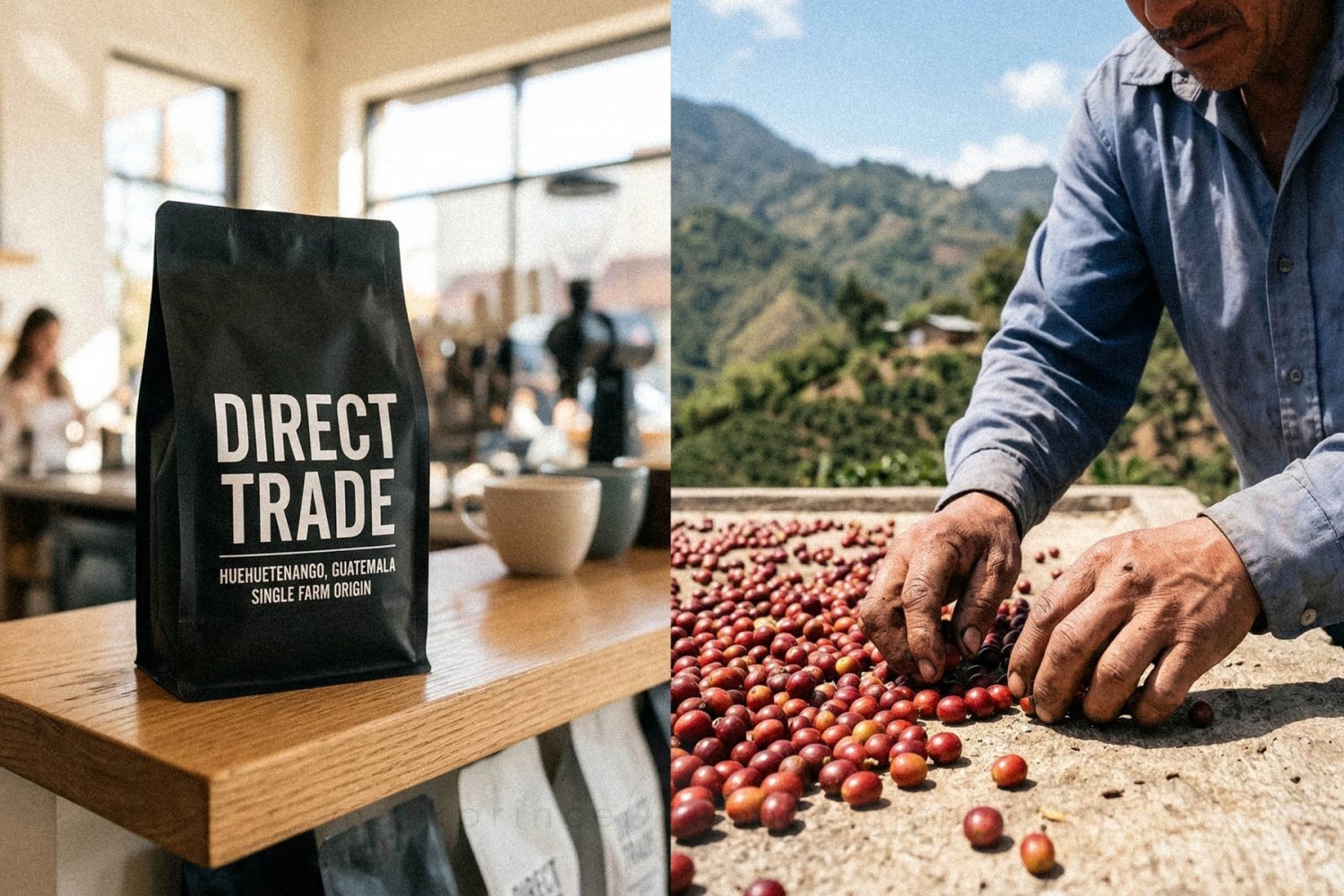





The bag on the shelf looks trustworthy. It says direct trade in clean sans-serif type, just below the tasting notes and just above the name of a farm in Huehuetenango. There’s a photograph of a man in a field. He is smiling. The implication is clear: buying this coffee does right by him.
Maybe it does. Maybe it doesn’t. The honest answer is that the label alone won’t tell you.
The three terms you’ll encounter most often on specialty coffee packaging are direct trade, fair trade, and commodity. They describe genuinely different relationships between buyer and producer. Understanding what each one actually requires, and where each one falls short, is worth your time. Not because you should feel guilty about your morning cup, but because this year more than most, the economics behind those labels have real consequences for real people.
Where “Direct Trade” Actually Came From
Before we get into what these labels mean today, it helps to understand where the most contested one came from.
In the late 1990s and early 2000s, a small group of green coffee buyers were traveling to origin and finding themselves frustrated. The coffee they were buying passed through so many hands that even importers often couldn’t tell them which farm it came from. Quality was inconsistent and largely unverifiable. The pricing system rewarded volume, not excellence. And the farmers growing the best coffee had no way to be recognized or compensated for it.
Geoff Watts, then the green coffee buyer at Intelligentsia Coffee in Chicago, is widely credited with coining the term “direct trade” to describe a different approach. He and Peter Giuliano of Counter Culture Coffee in Durham, along with Stumptown‘s Duane Sorenson in Portland, were traveling to farms, building personal relationships with specific producers, and paying prices tied directly to quality rather than to commodity market fluctuations. They were writing the model from scratch, sharing ideas across roasters, and collectively changing what it meant to source coffee responsibly.
Intelligentsia began using “Direct Trade” as an unregistered trademark around 2002. Stumptown put the words on its bags and helped bring the concept to a wider public. Counter Culture built its own sourcing philosophy around the same principles. For a moment, it felt like a genuine movement.
All three of those original roasters are now owned by large corporations. Stumptown and Intelligentsia are both owned by Peet’s Coffee, which is itself owned by Keurig Dr Pepper. Counter Culture remains independent, though the landscape around it has changed enormously. The ideals Watts and Giuliano articulated are still meaningful. Whether they survived the consolidation is a question worth asking every time you see those two words on a bag.
Commodity Coffee: The Baseline
Most coffee in the world, from the grocery store cans to the office drip to the fast food cup, is commodity coffee. It trades on the C-market, the Intercontinental Exchange’s benchmark for arabica coffee, and its price swings constantly based on weather forecasts, currency fluctuations, and speculative trading by people who will never touch a coffee cherry.
For much of the period between 2017 and 2020, the C-market sat below $1.00 per pound. The cost of producing a pound of washed arabica in many Latin American countries runs between $1.20 and $1.60 per pound once labor, fertilizer, water, and processing are accounted for. At those prices, farmers absorbed losses on every harvest.
2025 looked different on paper. The C-market broke $4.00 per pound for the first time since the 1970s, driven by the severe 2024 drought in Brazil, ongoing supply pressures in Vietnam, and significant volatility following the Trump administration’s import tariffs on coffee from most major producing countries. Those tariffs, which reached 50% on Brazilian coffee and 20% on Vietnamese imports, sent U.S. retail prices up roughly 21% year over year. A bag of commodity ground roast that cost $7 in 2023 crossed $9 by late 2025. As of early 2026, the C-market has pulled back to around $2.94 per pound as Brazil’s 2026 harvest is forecast to recover, but retail prices have not followed it down.
Here is the part that rarely makes the headlines: high C-market prices do not automatically translate into better lives for farmers. The C-market is a financial instrument. The money that moves when prices spike often moves between traders, hedge funds, and futures speculators. Whether any of it reaches the smallholder whose harvest set off the forecast that moved the market is a separate question entirely, and frequently the answer is: not much, and not quickly.
Commodity pricing is not a relationship. It is exposure to a market that has no mechanism for caring whether the farmer survives.
Fair Trade: A Floor, Not a Solution
Fair Trade certification, administered primarily by Fairtrade International and Fair Trade USA, was designed to address exactly this problem. It sets a price floor, currently $1.80 per pound for washed arabica, below which certified buyers cannot pay regardless of what the C-market is doing. It also requires a social premium, an additional $0.20 per pound paid directly to the farmer cooperative for community investment: schools, health clinics, infrastructure.
This is genuinely meaningful. When the C-market collapses, Fair Trade certification protects farmers from the worst of it. The social premium has funded real things in real communities. These are not nothing.
But Fair Trade has structural limits worth understanding. Certification applies to cooperatives, not individual farmers, which means smallholders who are not cooperative members are excluded entirely. That is a significant portion of the world’s coffee farmers. The certification process carries fees that smaller cooperatives sometimes struggle to afford. And when the C-market trades above the Fair Trade floor, as it did throughout much of 2024 and 2025, the floor becomes irrelevant and Fair Trade offers no price advantage at all.
There is also the question of adequacy. A floor of $1.80 per pound was set for a different market and has not kept pace with rising production costs, climate-related losses, or the tariff pressures now hitting the supply chain. Fair Trade is a safety net with holes in it. It was never designed to be a comprehensive solution, and it should not be marketed as one.
Direct Trade: A Promise Without a Regulator
Here is where language and reality diverge most sharply, and where the legacy of Watts, Giuliano, and Sorenson gets complicated.
“Direct trade” has no governing body, no certification standard, no third-party verification, and no agreed definition. It remains, as it was in 2002, an unregistered term. Any roaster can print it on any bag.
At its best, direct trade describes something genuinely valuable: a roaster or importer who travels to origin, builds a real relationship with a specific farm or cooperative, negotiates a price directly, pays significantly above Fair Trade minimums, and returns year after year. Intelligentsia’s published standards, still accessible on their website, commit to paying at minimum 25% above Fair Trade prices and to visiting direct trade partners at origin at least once annually. I have seen this model work. I have sat at tables where those negotiations happened and watched farmers receive prices that changed what was possible for their families and their land.
At its worst, direct trade means a roaster bought coffee from a broker who bought it from an exporter who sourced it from a washing station that aggregated cherries from dozens of farms, and somewhere in that chain someone visited origin once and took a photograph. The farmer in the picture may have received commodity prices. The bag still says direct trade.
The gap between these two things is enormous, and nothing currently stops a company from occupying any point on that spectrum while using identical language. Trish Rothgeb, who coined the term “third wave” and has spent decades observing the industry, put it plainly: without foundational documents and policing mechanisms, direct trade more often than not is a marketing strategy wrapped in a cloak of virtue.
What to Actually Look For
This is not an argument for cynicism. It is an argument for specificity.
When a bag says direct trade, look for details. Does it name a specific farm or cooperative rather than just a region? Does the roaster publish the price they paid, or at minimum confirm it exceeds Fair Trade minimums by a meaningful margin? Do they have a documented ongoing relationship with that producer across multiple harvests, not a single purchase? Some roasters answer these questions openly on their websites. Those are the ones whose claims are worth taking seriously.
Fairtrade International certification, for all its limitations, is at least verifiable. Look for Fairtrade International certification rather than Fair Trade USA if you want the stricter standard. The two organizations split in 2011 and have different requirements, a distinction the packaging rarely makes obvious.
And pay attention to price. In a market where retail bags have crossed $9 per pound for commodity-grade ground coffee, genuinely sourced specialty coffee will cost more. If the price seems too low for the story on the label, trust the price. Coffee that was grown with care, purchased at a price that let the farmer reinvest in next season’s crop, and imported through a relationship rather than a broker does not come cheap. It never did.
The Larger Point
The people who created direct trade had serious moral intentions. Geoff Watts and Peter Giuliano were not building a marketing category. They were trying to construct a trade model that worked better for everyone, producers included. The roasters who carry that work forward honestly are doing something that matters.
The problem is not the intention behind the term. It is the gap between what it promises and what it guarantees, and the ease with which that gap can be exploited.
That gap is where marketing lives. And in a year when American consumers are paying record prices for coffee while farmers in many origins are still fighting for sustainable returns, understanding that gap is not a minor consumer concern. It is the whole story.
Marisol Rivera is a Santa Fe-based writer and journalist who is now covering the global coffee trade for CoffeeGeek. With a background in anthropology and over a decade of field experience across Latin America, East Africa, and Southeast Asia, she brings a ground-level perspective to stories about origin, supply chains, labor, and the environmental realities of coffee production.
Before turning to journalism, Rivera worked as a roaster and later as a green coffee buyer for a direct trade importer, giving her firsthand experience on both sides of the buyer-producer relationship. She has visited farms, wet mills, and processing facilities across multiple continents, and writes for the full spectrum of CoffeeGeek readers, from curious beginners to seasoned specialty coffee enthusiasts.

















One Response
Great breakdown of direct trade and what it actually means for farmers. One thing we’ve found in our work connecting coffee lovers to smaller producers is that the roasters doing the most meaningful direct relationships are often ones most people have never heard of — small shops buying directly from one or two farms they’ve visited in person.