
-
Barista Assist Technology: The machine monitors your grind and brew time, offering specific guidance on the display to adjust the grinder finer or coarser for the next shot, taking the guesswork out of dialing in.
-
Cold Brew & Cold Pressed: Unlike most machines that just brew hot over ice, the Luxe Café uses lower pressure and temperature profiling to create genuine cold extraction espresso and filter style coffee.
-
Dual-Stack Weighing System: While marketed as grind-by-weight, it likely uses a smart timer system that weighs the dose post-grind to calibrate future grinding times, keeping your 18g dose surprisingly consistent.
-
Hands-Free Steam Wand: The wand combines steam and a mechanized internal whisk to create various textures—from flat white to cappuccino foam—automatically, and even purges itself into the drip tray when done.
-
The Luxe Basket: A proprietary, extra-deep filter basket that holds up to 40g of coffee, allowing for "Quad shots" or the machine's unique filter-style coffee and cold brew beverages.
-
Near Zero Warm-Up Time: Utilizing an advanced thermoblock system, the machine requires minimal morning pre-heat routine. It heats the water and grouphead effectively on demand, ready to brew seconds after powering on.
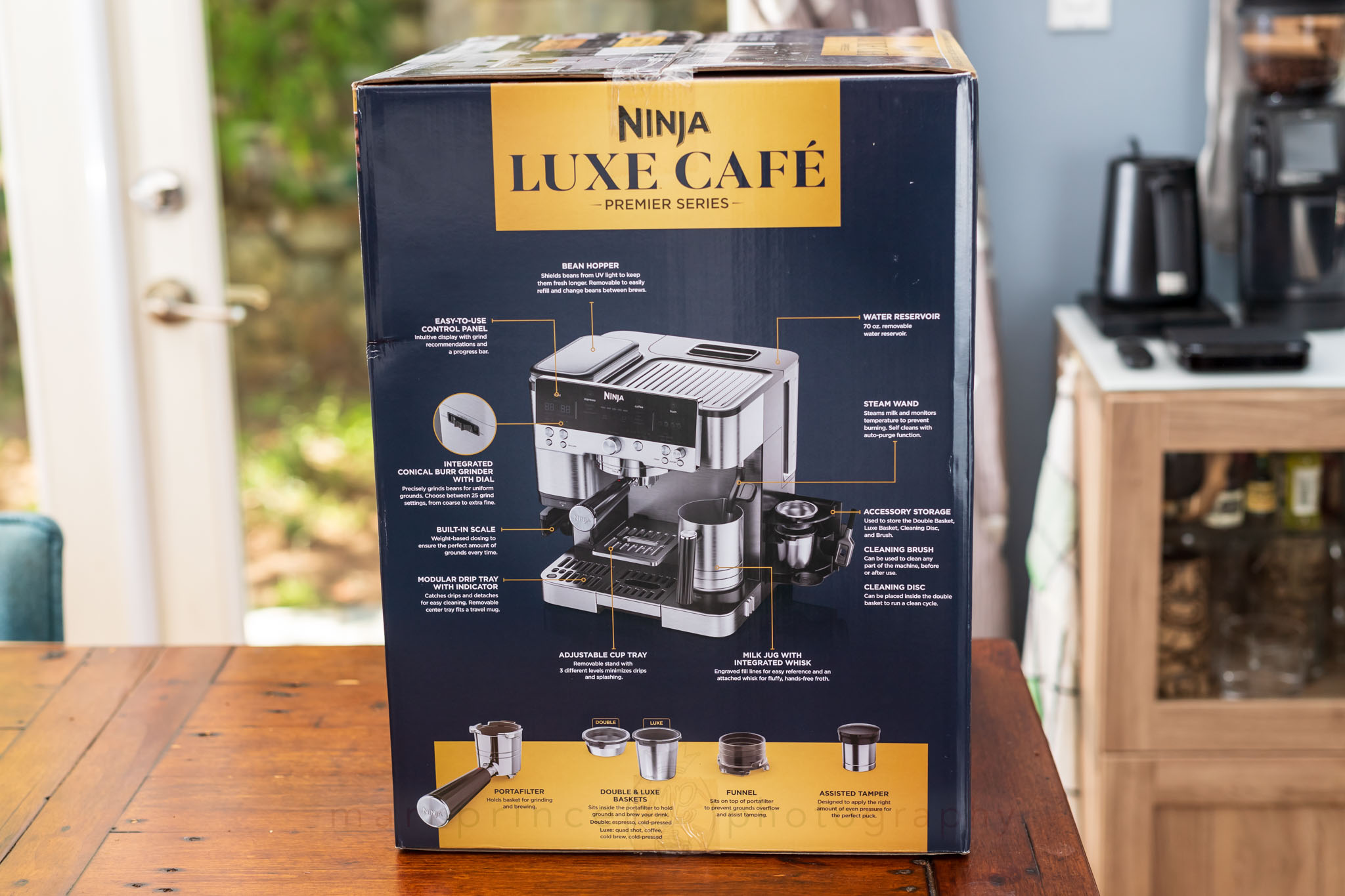
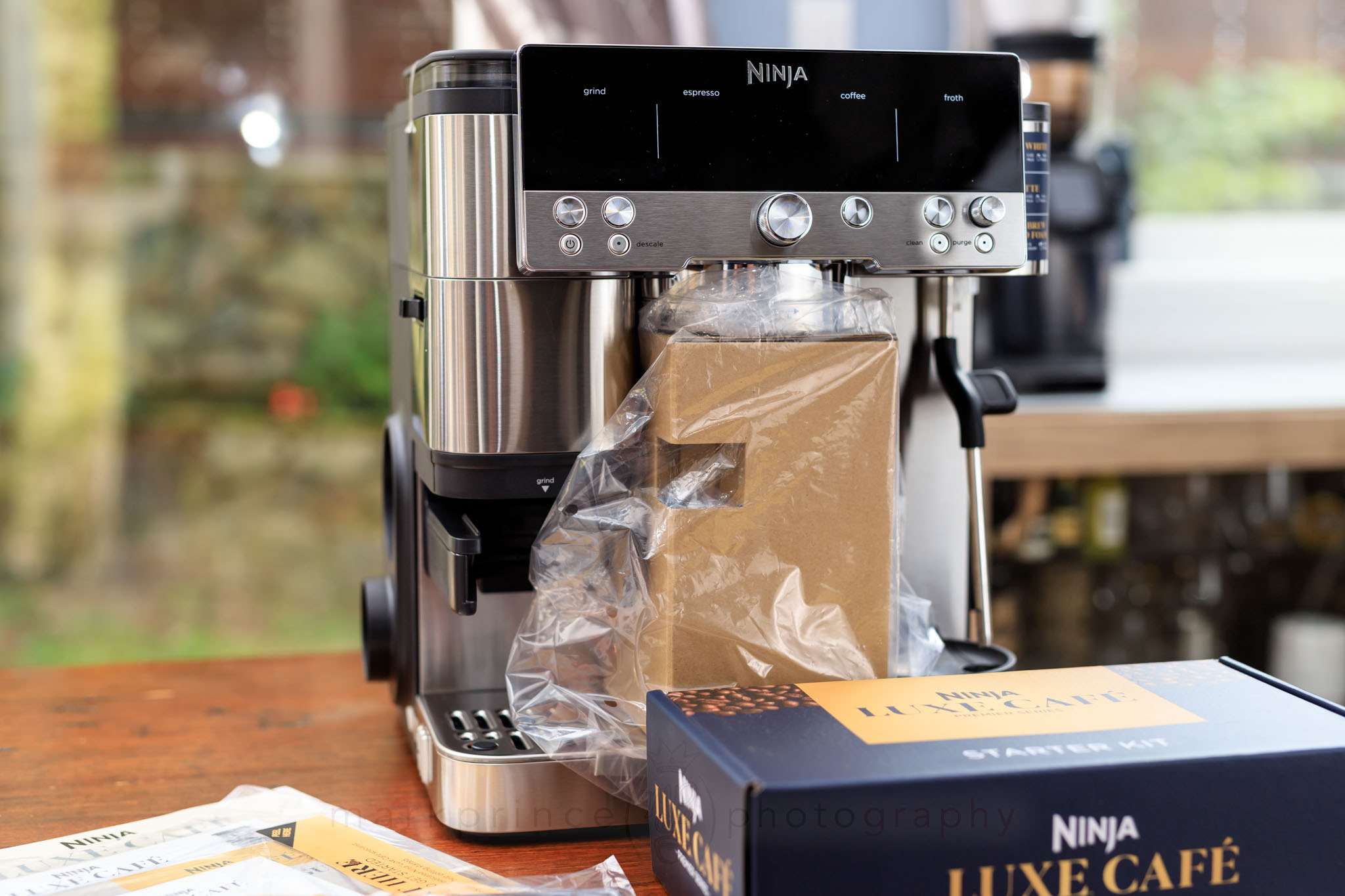
Let’s be real for a second: Ninja is a company with infomercial DNA. Their parent company, Shark, cut their teeth selling vacuums to insomniacs on late-night TV, and that heritage still exists in the Luxe Café Premier (ES601). The box practically screams “As Seen on TV.” It is covered in splashy graphics, bold claims, and enough reading material printed right on the cardboard that you could probably skip the manual entirely (sidenote: don’t; always RTFM). It is loud, it is busy, but hey, you definitely know what you just bought.
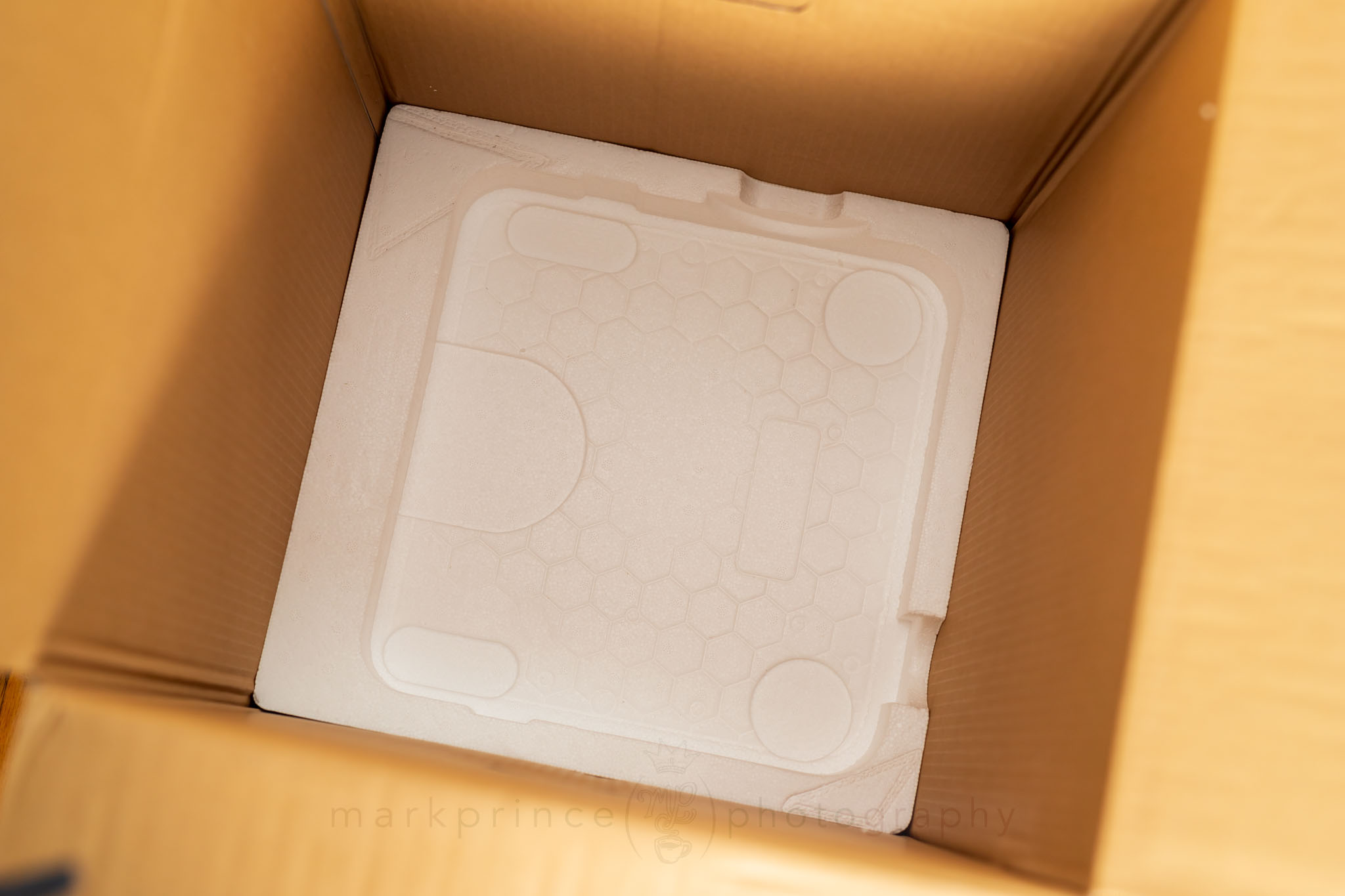
But here is where I have to get grumpy. We take sustainability seriously at CoffeeGeek. The machine is packed in a mountain of polystyrene. Styrofoam, people! In this day and age. If Breville can ship the massive Oracle Jet in fancy molded cardboard and Rancilio can go plastic-free, surely Ninja can figure it out. Come on, Shark folks: read the room. Make an environmental statement and be a leader, not a landfill filler.
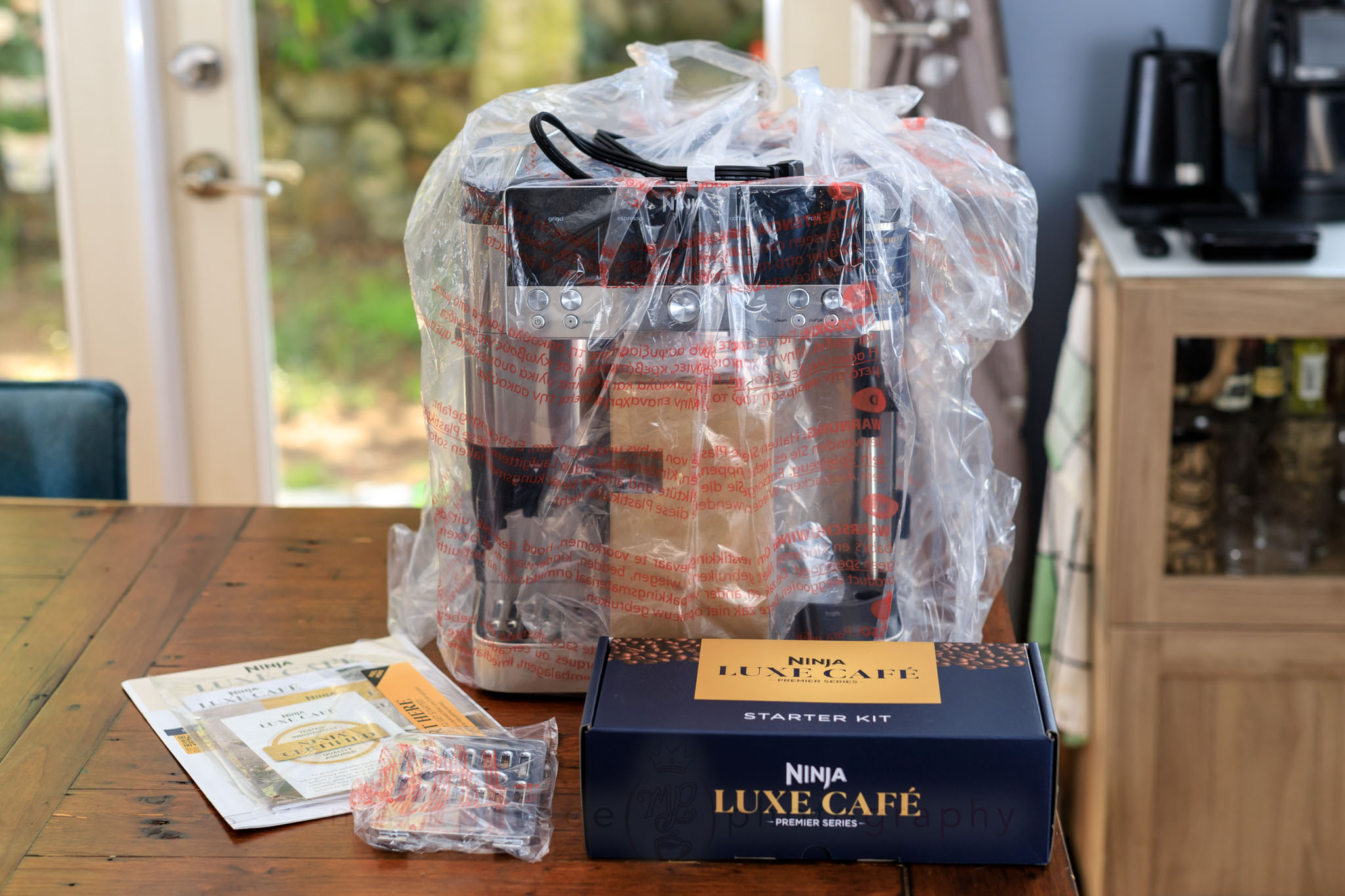
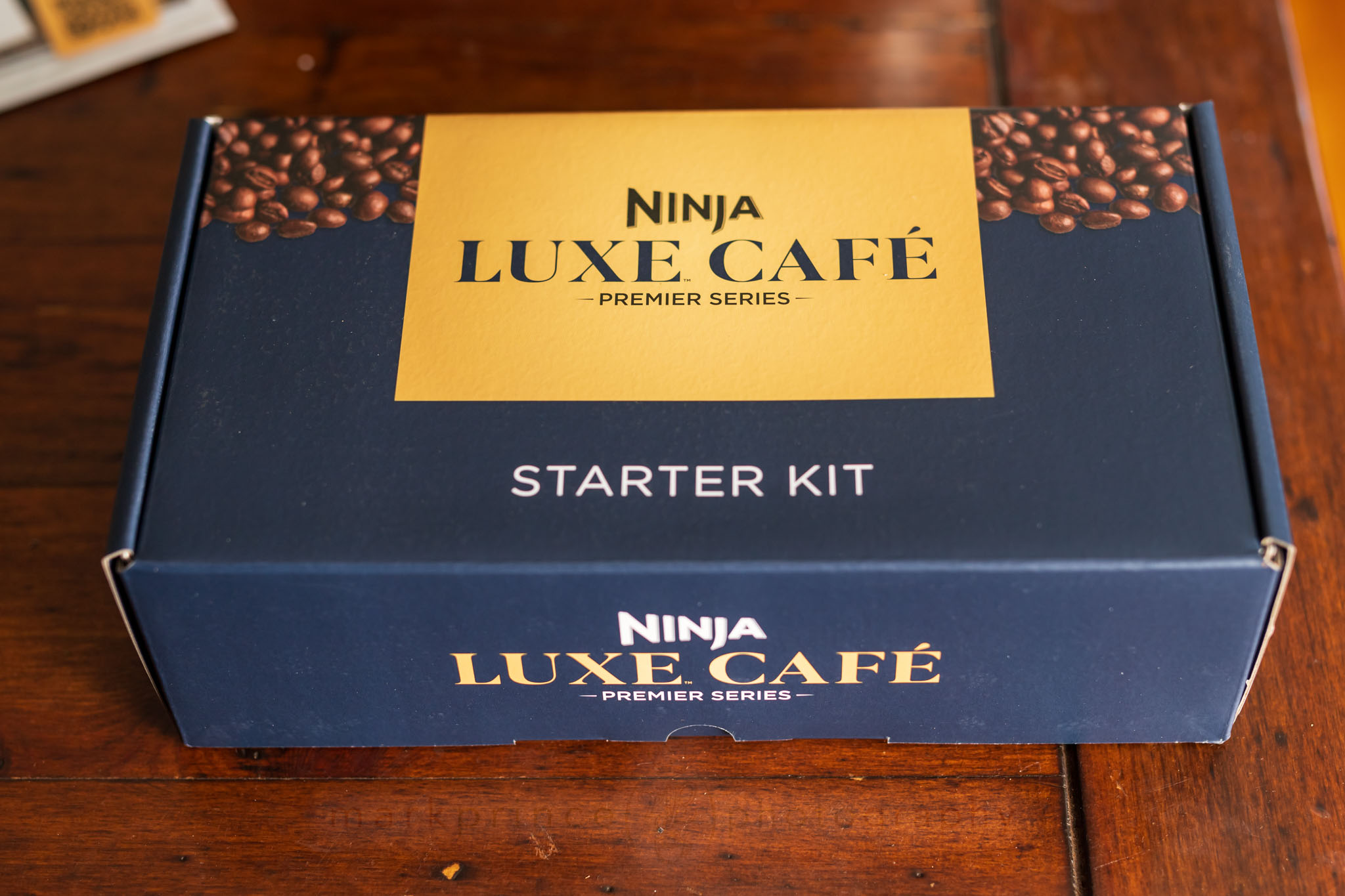
After removing the paperwork, you’ll find a chromed metal cup tray, and the Luxe Café Starter Kit nestled in styrofoam. Once those are removed, the machine itself is revealed all wrapped in a plastic bag.
Inside the starter kit, you get the portafilter (we will get to that unique bit later), a standard double basket, and their massive “Luxe” basket. Thankfully, neither are pressurized, which is a great sign. You also get a surprisingly decent click-pillar tamper, the mandatory dosing collar, and the usual cleaning suspects like a brush and blind filter. Gratefully missing? That useless plastic double-scoop spoon most cheap machines include. We definitely don’t miss it.
Digging the machine out, there is another box, holding the milk pitcher, tucked under the grouphead. This thing has a magnetic whisk in the bottom, so don’t lose that. Then comes the ritual of peeling off about a mile of blue tape securing everything. Once it is naked, the Luxe Café actually looks pretty good. It has real brushed steel plates where it counts, specifically on the front, top, and sides, balanced out by some high-quality dark grey plastic. It doesn’t look like a toy, which is a relief.
Let’s now look at the machine in more detail.
Machine, Top to Bottom
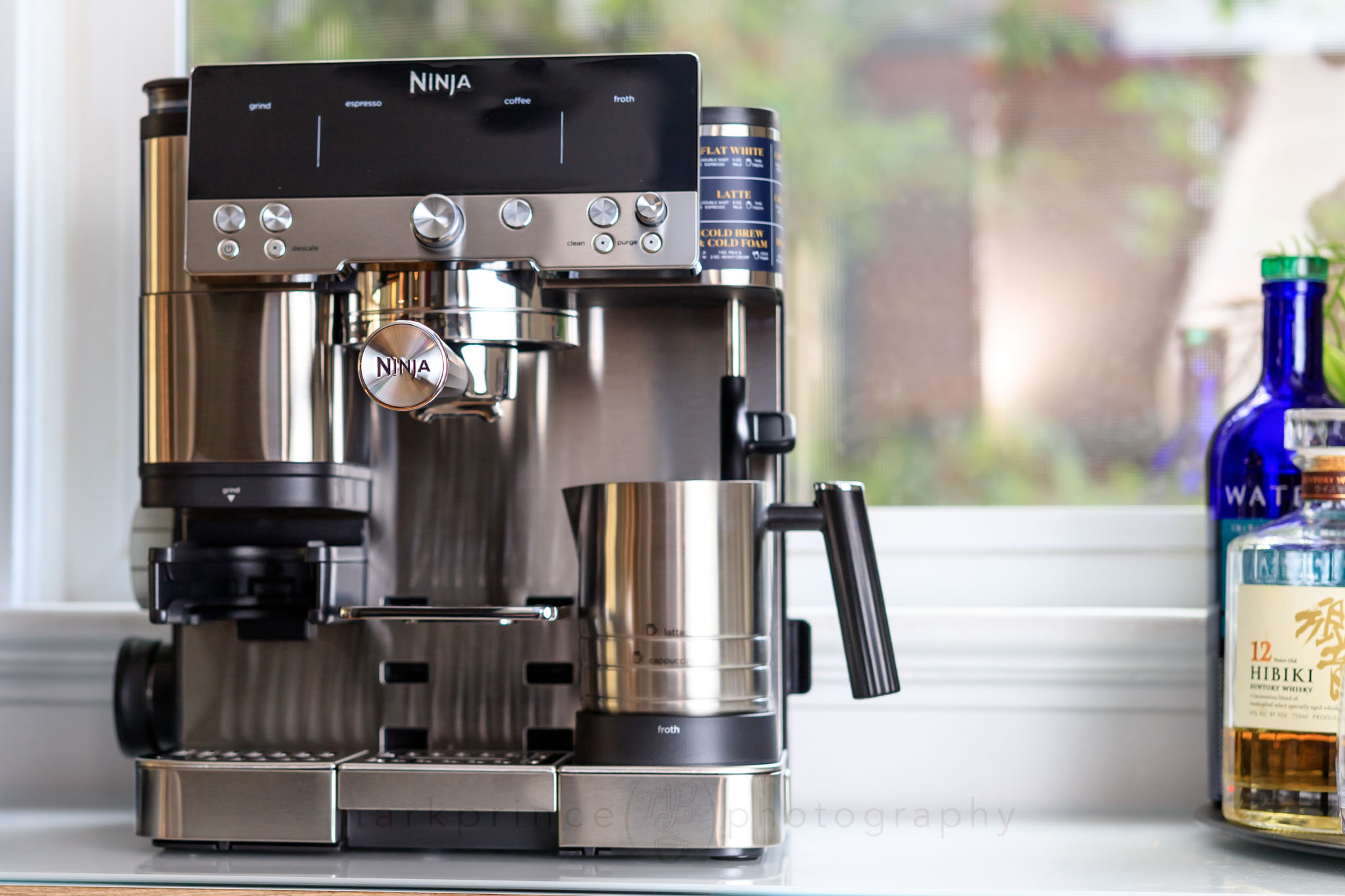
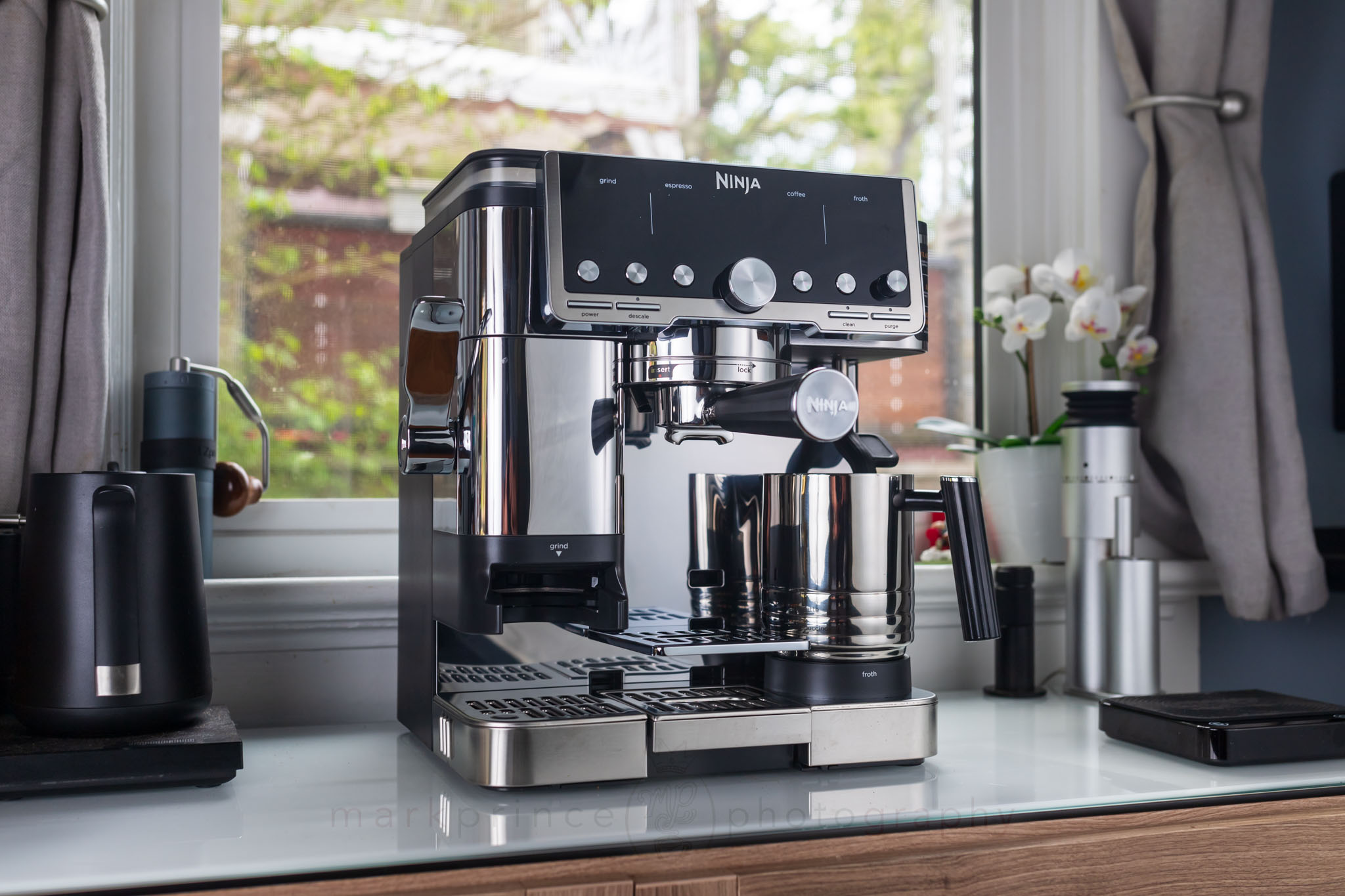
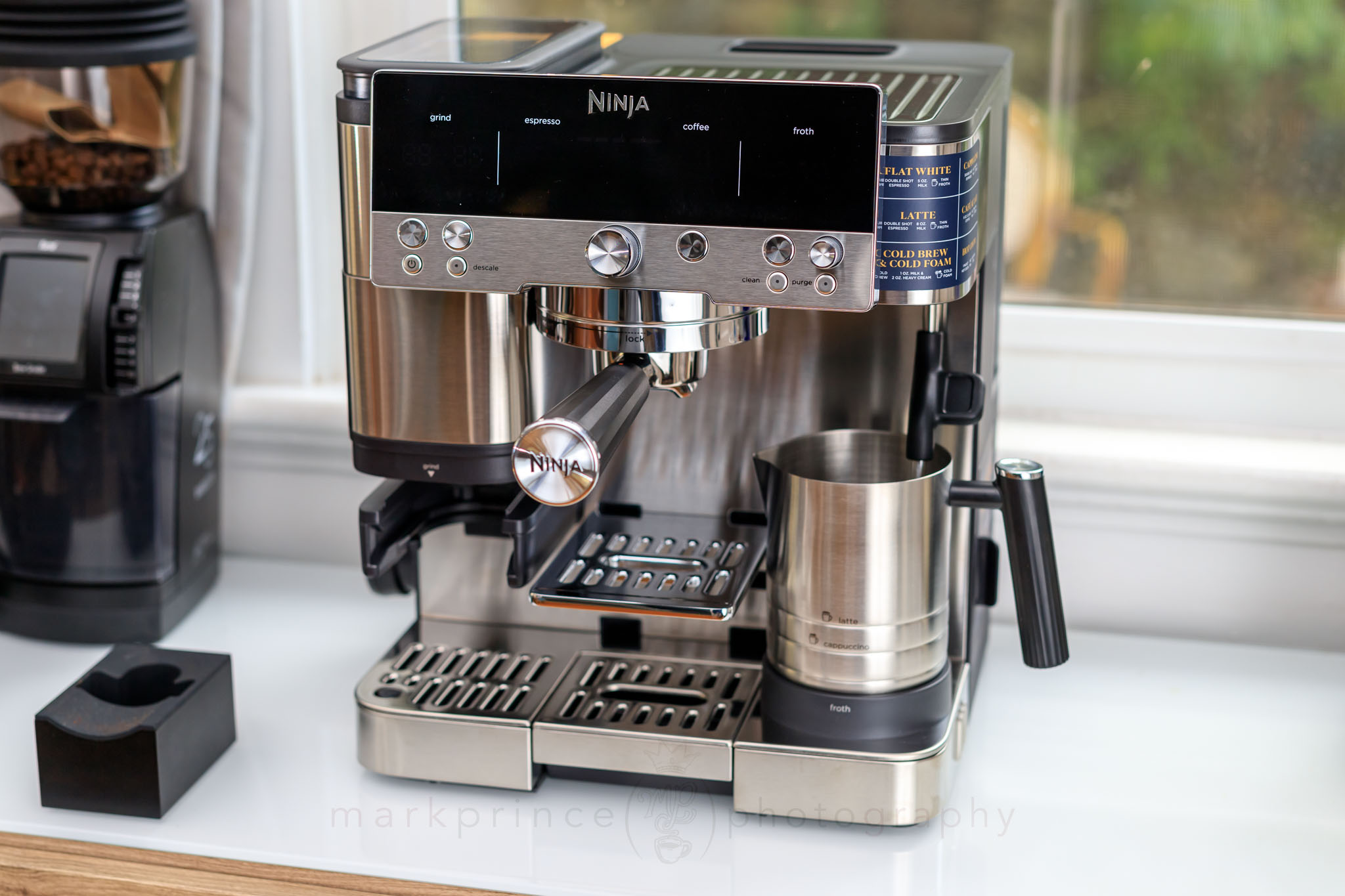
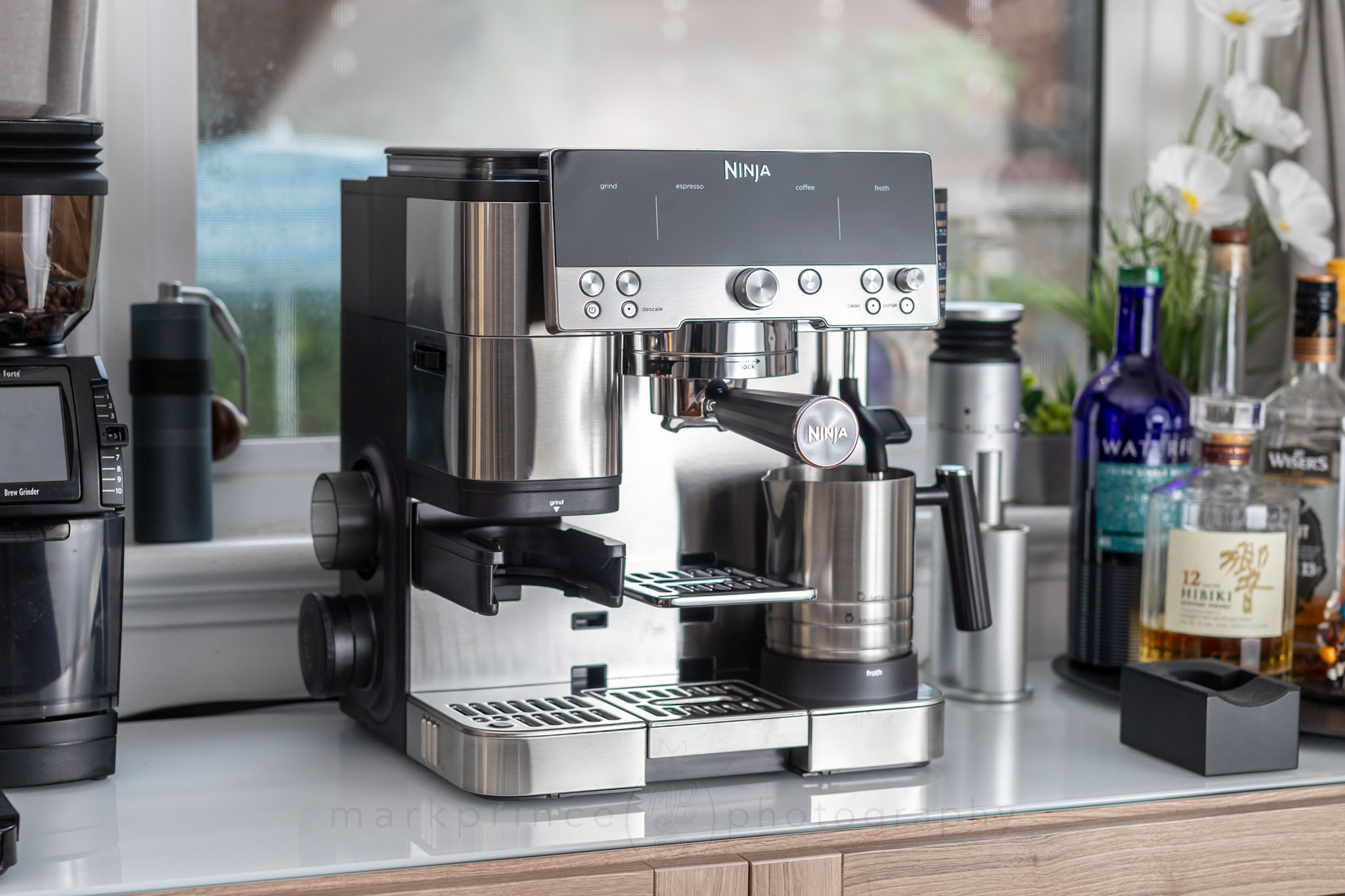
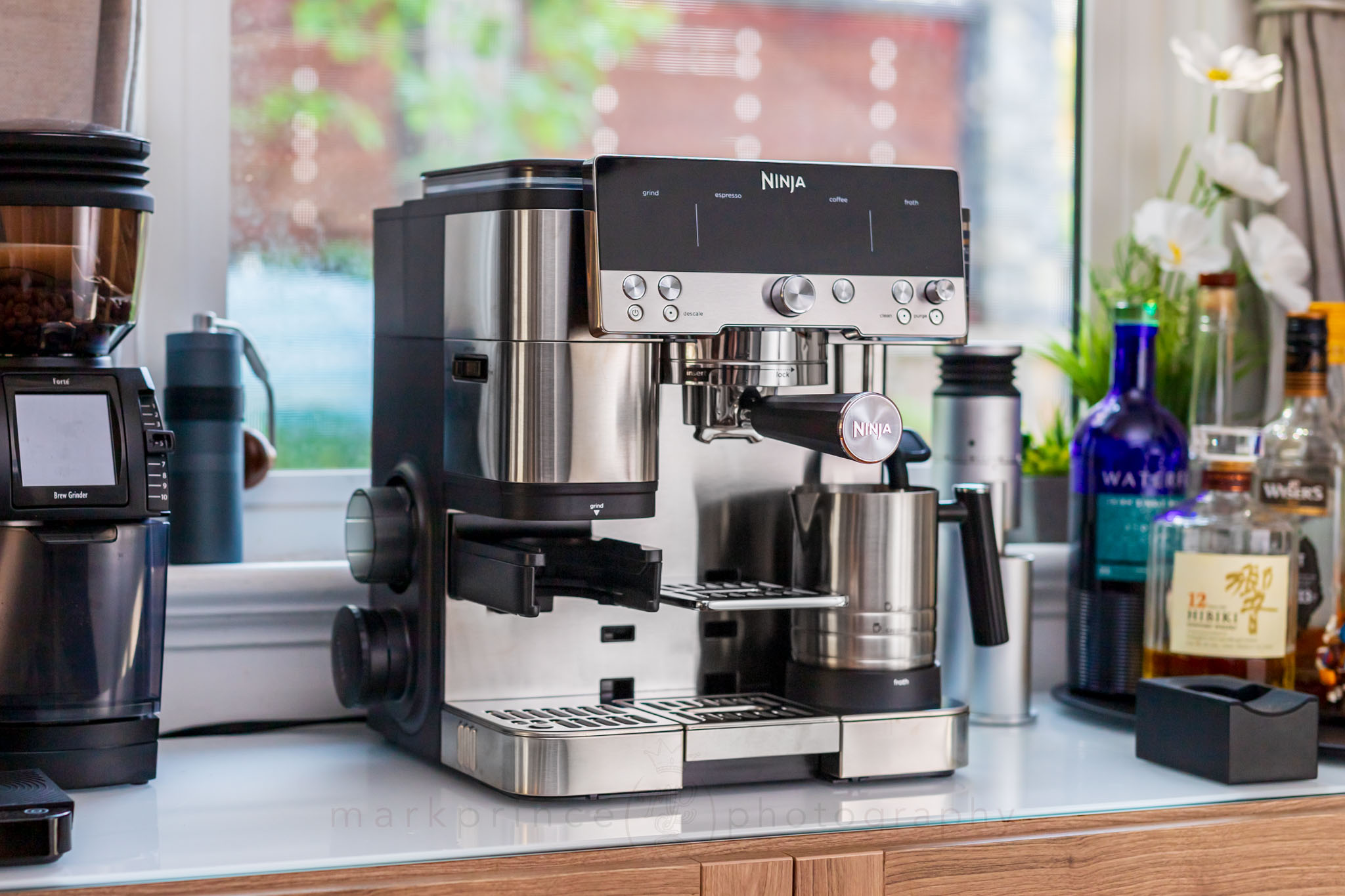
There’s a lot to cover with the Ninja Luxe Café, but I’ll let our photos speak for themselves, aside from the detail we get into with the control panel.
At the top, you’ll find the bean hopper for the grinder, a cup warmer, and the lid for the removable reservoir. The grinder hopper low-profile design is a nice touch, making it more under-counter friendly. The cup warmer is large and features a brushed stainless steel ridged plate.
The reservoir holds 2 litres of water and has a low water sensor (something missing from the Breville Barista Express). However, it lacks a built-in water filter, which is surprising since all espresso machines should have one, and it would be a long-term profit opportunity for Ninja to sell replacement filters to owners.
Moving down the front of the machine, you come upon the Luxe Café’s rather busy control panel, which has many LEDs and indicators. While it lacks a fancy OLED screen, it makes up for it with plenty of bright lights and number readouts. It might look a bit intimidating at first, but trust me, it becomes second nature after using it for a week. The top half is sleek glossy black glass, while the bottom half gets down to business with brushed steel buttons and knobs.
The panel is split into three distinct zones. The left side primarily runs the grinder show, and also includes options for espresso temperature (you get three choices) and the descale button. It displays your current grind setting and even recommends where you should be based on your drink choice. It also helpfully nags you to tamp the coffee after grinding, whether for espresso or the larger 16 to 18oz brewed coffee drinks.
The middle section is mission control for drink selection. A central dial lets you scroll through options like espresso, quad shot, cold pressed espresso, and the various hot and cold coffee brewing methods. The machine tells you exactly which basket to swap in and lets you pick a brew size from 6 to 18 fl. oz with a button push. If you long press that size button, you access the advanced menu, which you can read about in the manual if you are feeling brave (or read on in this review).
The right side is all about the milk. You get four main options: no froth, low, high, and cold froth. “No froth” is what you use for manual steaming since it kills the spinning whisk mode, while cold froth uses no steam at all, just the magnetic whisk spinning away. You also have controls to tell the machine if you are using dairy or plant-based milk, foam type selectors, a clean button, and a purge button to blast the wand before use.
Continuing down the machine, you reach the main “business” area: the grinder doser, grouphead brewing area, and steaming platform.
The grinder only works with Ninja’s dosing collar; if you insert the portafilter into the grinder cradle without it, the machine won’t operate and alerts you on the display. The doser cradle includes a built-in scale, which Ninja markets as “Grind by Weight,” though our testing suggests it is actually an Adaptive Time Based Dosing (non official name) system that weighs the output post-grind to calibrate the next shot’s timer.
The grinder and burr assembly resemble the Barista Express, though there are differences. It features a removable conical top burr but cannot be micro-adjusted like Breville grinders. The grinder is fast, and the removable hopper holds up to 12 oz of coffee (350g). It features a bean shut-off system that allows you to remove a half full hopper without spilling beans everywhere.
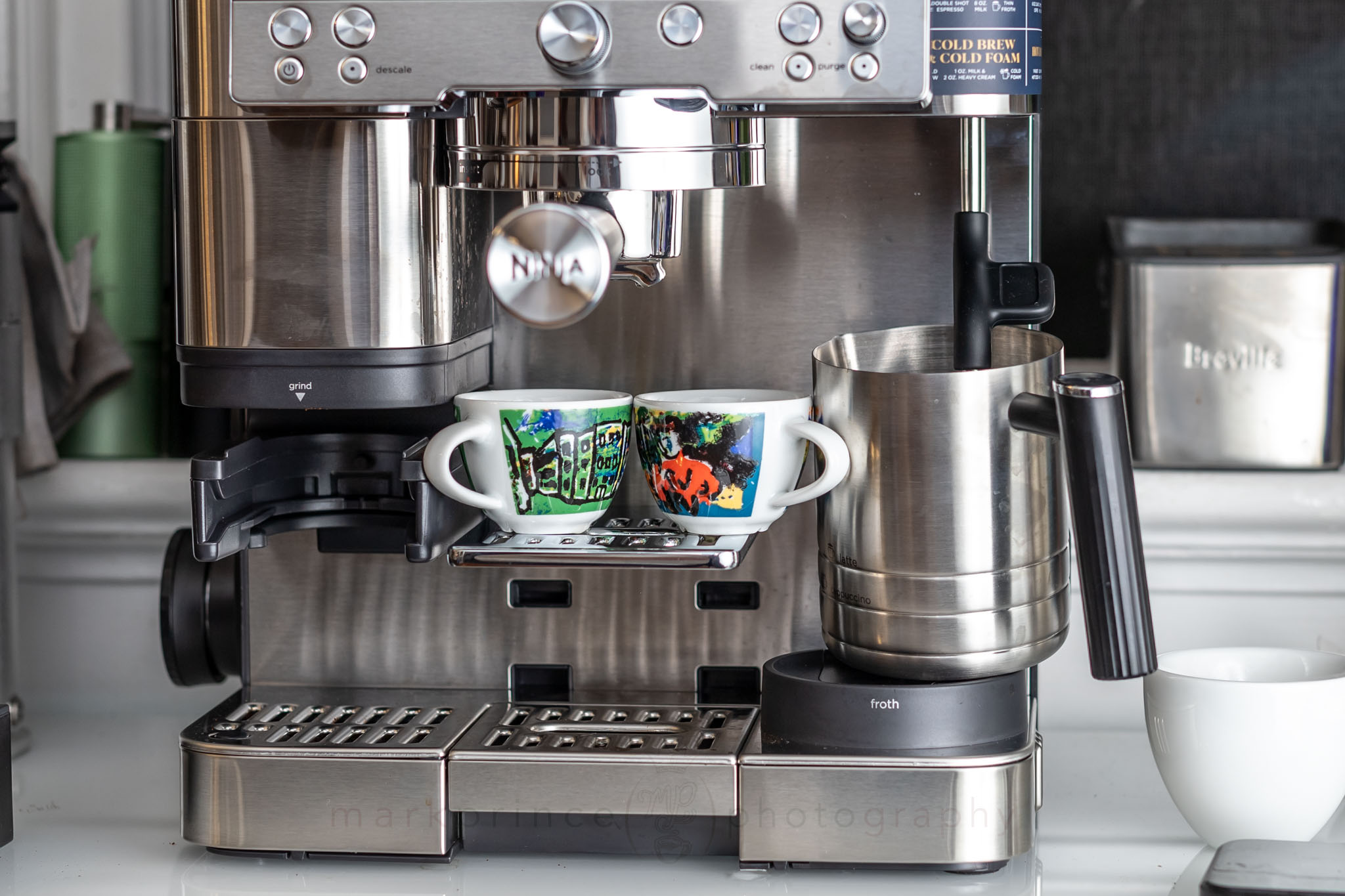
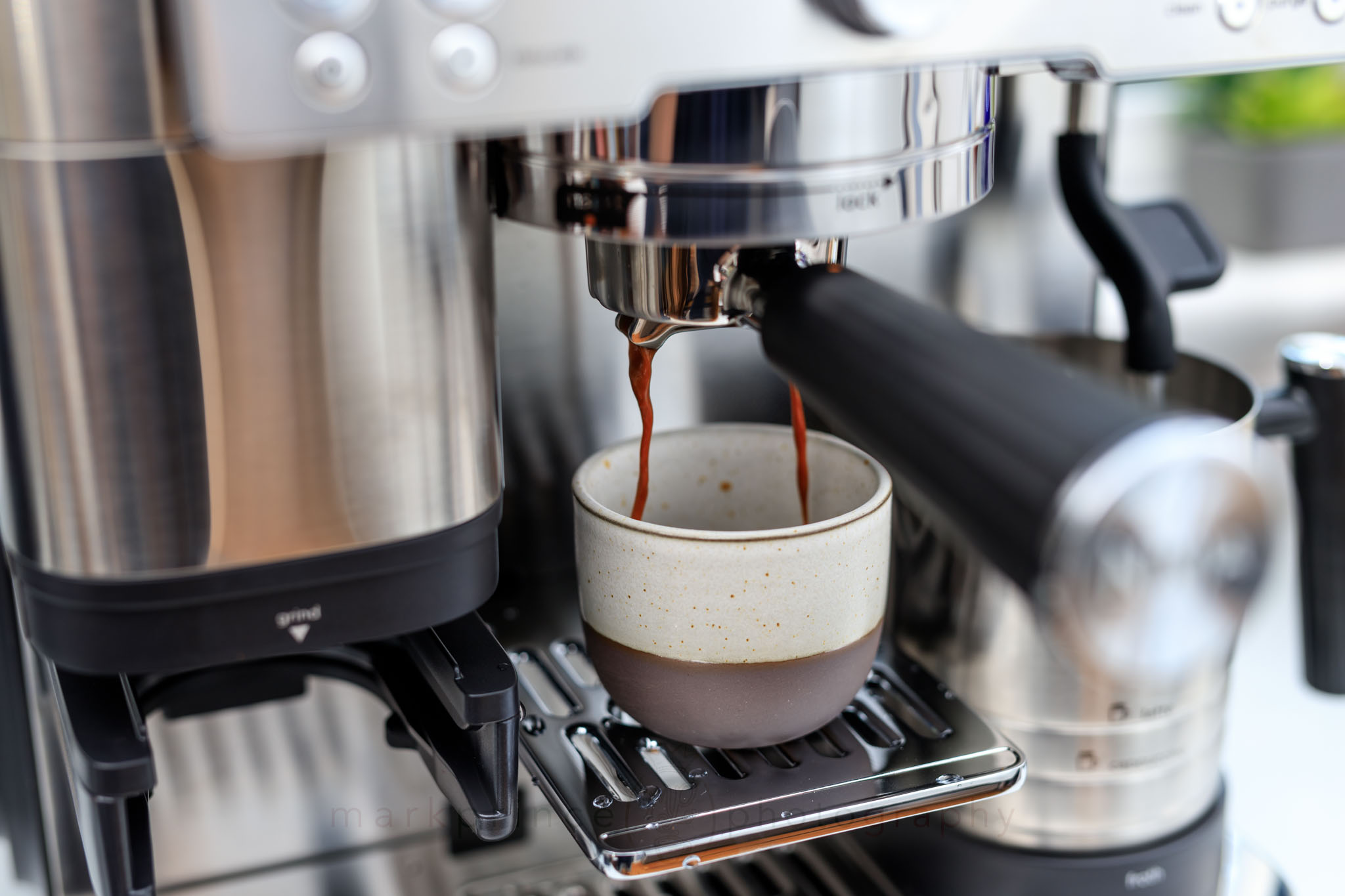
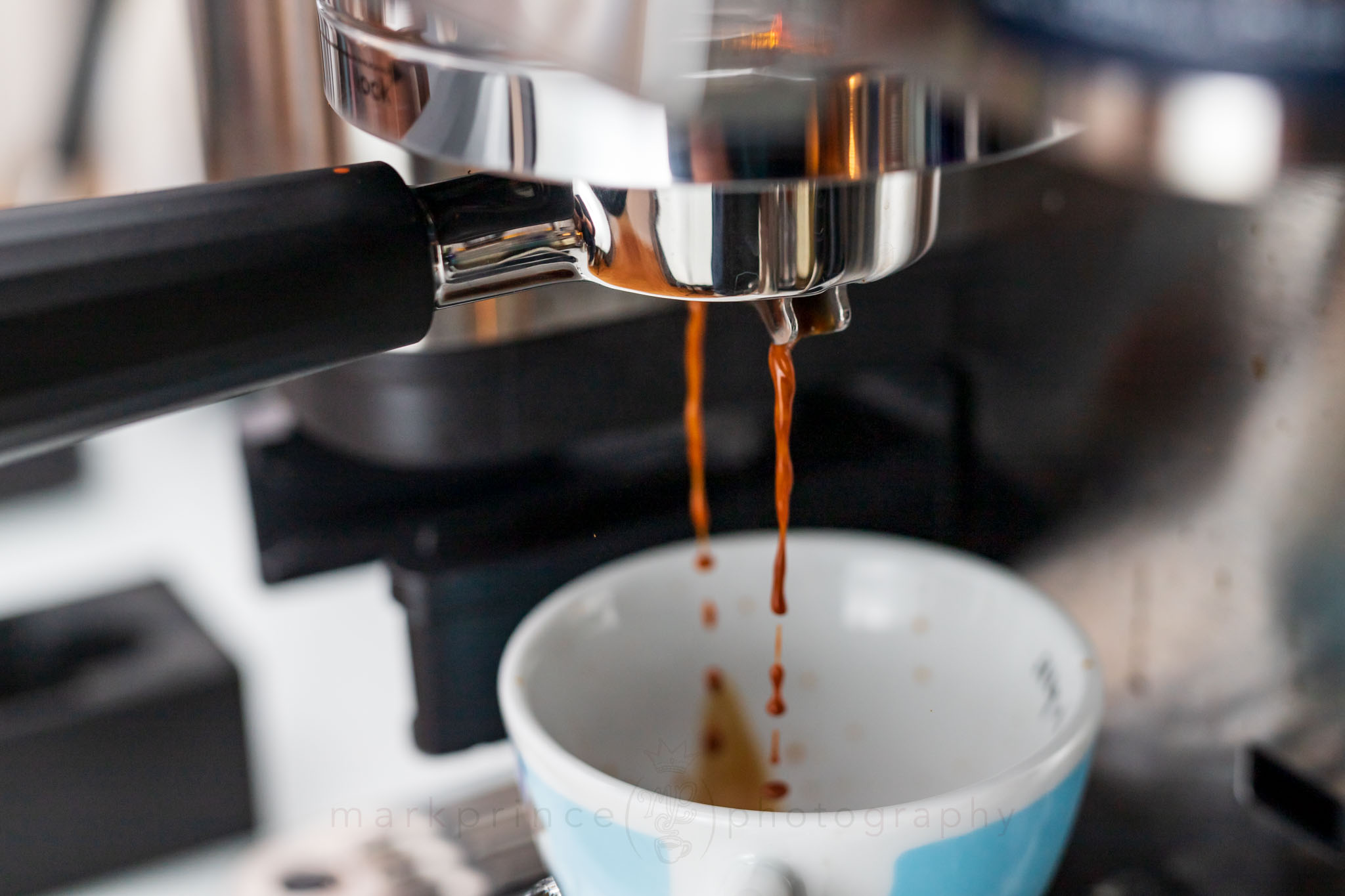
Another unique element of the Luxe Café is the grouphead and portafilter. The 53mm chromed brass portafilter is extremely deep with two spouts cast into its design. Why it has two spouts is remains a mystery, because you cannot fit two espresso (or larger) cups on the elevated or base drip trays. The handle is weighted, featuring a metal Ninja logo at the end cap. While it shares the triple bayonet design of Breville’s 54mm portafilters, they aren’t compatible due to the recessed grouphead designed for the deeper portafilter.
Ninja’s filter baskets are also incompatible with standard 54mm Breville baskets or aftermarket baskets made for Breville machines. The Luxe Café baskets feature rubber insets, fitting only one way into the portafilter. The machine includes two baskets: a standard double basket for up to 18g of coffee and an extra deep “Luxe” basket, holding up to 45g. Thankfully, neither are pressurized. Also thankfully, Ninja sells replacements for these on their website at decent prices.
And there’s still more unique design choices to explore on the Luxe Café: its dual cup tray designs. A removable “mini” tray fits into the main drip tray. This allows the machine to accommodate large 18-20oz insulated cups by removing the mini tray and placing the cup directly on the counter. Since the Luxe Café uses a 3-way solenoid valve to release pressurized water after a shot, the main drip tray catches this purge water even when the mini tray is removed.
The second removable cup tray, made of thick metal, can be slotted into one of three positions, allowing you to move your espresso cup closer to the two spouts (again, why does this machine have dual spouts?).
On the right side of the business area is the milk station with a cradle for the Ninja Luxe Café pitcher. It includes a temperature sensor, a purge hole directing steam wand water to the drip tray, and a hidden magnetic stirrer to spin the frothing whisk inside Ninja’s steam pitcher at different speeds.
The pitcher has markings for milk levels, and the frothing whisk is easily removable due to its magnetic attachment.
On the left of the machine is the grind adjustment dial and slots for the tamper and dosing collar. More innovation can be found in the grinder adjustment settings: as long as the portafilter and doser collar are in the grinder cradle, each click finer you set on the grinder activates the motor for milliseconds, to purge some grinds and prevent damage to the burr carrier. We thought this was brilliant when we first saw it, and it remains so today (and something no other grinder maker or company making combi machines has duplicated).
You can also further purge the grinder of any left over grinds by pressing and holding the front mounted grinder button.
The tamper is a pillar design, and has a click effect with about 30lb of pressure applied. It is designed to work with the dosing collar, and using both ensures a very level pack on the ground coffee. Users have found that giving the portafilter a quick horizontal shake (our buddy Coffee Kev calls it the “Ninja Shake”) before removing the collar helps settle the fluffy mound of coffee and prevents spills.
The Ninja Luxe Café Premier model is smaller in real life than it looks in photographs; at least that was my initial impression. It sits just 37cm tall (14.5”), and will have no problem sitting under most kitchen cabinets. It is 34cm wide (13.25”) but you need a bit more clearance on the side for the tamper and dosing collar storage. Back to front it is just 33cm (over a foot at 13”).
The machine weighs 12.5kg (around 25lb). It runs at a full 1650W when doing everything, but my initial tests with a Kill-a-Watt meter show it manages that power well and is pretty efficient, drawing low power most of the time. The cord is 1m long, which to me is a perfect length for most kitchens, but some might find it too short.
Lastly, the warranty is one year, though there are options to extend that if you buy directly from the manufacturer.
Technical Specifications
If you are a tech specs geek, here are the full main specifications for the Ninja Luxe Café Premier, ES601 Model.
| Feature | Specification |
|---|---|
| Model Number | ES601 |
| MSRP | $549 USD |
| Machine Type | Hybrid Espresso, Drip & Cold Brew System |
| Pump Pressure | 15 Bar |
| Heating System | Single Thermoblock |
| Dimensions (H x W x D) | 37.1 x 33.0 x 34.0 cm (14.6" x 13.0" x 13.4") |
| Weight | 11.7 kg (25.7 lbs) |
| Power | 1650 Watts / 120V |
| Water Reservoir Capacity | 2.0 L (70 fl oz) – Removable |
| Bean Hopper Capacity | 340 g (12 oz) – Removable |
| Drip Tray Capacity | ~350 ml (12 fl oz) |
| Portafilter Size | 53mm (Stainless Steel) |
| Filter Baskets | Double Shot, Luxe/Drip (Non-Pressurized) |
| Espresso Drink Styles | Double Shot, Quad Shot, Cold Pressed Espresso |
| Coffee Drink Styles | Classic, Rich, Over Ice, Cold Brew |
| Coffee/Cold Brew Sizes | 177, 237, 296, 355, 414, 473, 532 ml (6, 8, 10, 12, 14, 16, 18 fl oz) |
| Programmable Temperature | 3 Levels (Low, Medium, High) |
| Programmable Milk Foam | 4 Presets (Steamed, Thin Froth, Thick Froth, Cold Foam) |
| Programmable Milk Type | Dairy, Plant-Based (Adjusts steaming profile) |
| Grinder Type | Integrated Conical Burr (25 Settings) |
| Tamping System | Manual Spring-Loaded "Assisted Tamper" |
| Interface | LED Display with Barista Assist™ (Grind & Dose Guidance) |
| Warm-Up Time | < 30 Seconds |
| Warranty | 1 Year Limited |
Subscribe to
Coffee Pulse
Join the 12,850 other coffee lovers who receive CoffeeGeek's premier newsletter. Each issue dives deep into one coffee or espresso based subject. Subscribing is free, and your personal information is never shared.
By submitting this form, you are consenting to receive marketing emails from: CoffeeGeek. You can revoke your consent to receive emails at any time by using the SafeUnsubscribe® link, found at the bottom of every email. Emails are serviced by Constant Contact

Support CoffeeGeek
If you enjoy and learn from this resource, please consider making a one time or recurring donation to help support our work and fund purchases for future reviews.
Before pulling a single shot, there are a few ground rules the Ninja Luxe Café Premier imposes on you. First, it simply won’t let you grind into the portafilter unless you attach the dosing collar stored on the side of the machine. The display will nag you until you comply. Second, you have very little “play” regarding your dose. The machine is programmed to grind approximately 17.5g to 18g of coffee for every double shot, and you cannot easily change this variable.
In our First Look, we speculated that the grinder wasn’t actually “Grind by Weight” as marketed, but rather a smart timer system. After extensive testing, we are confident this is an Adaptive Time Based Dosing system. The scale measures the finished weight of the coffee to judge the next dose. If a dose comes up light, the machine adjusts the timer for the next grind to run longer. It works well enough once dialed in, but don’t expect it to catch a sudden change in bean density instantly. We cover the pros and cons of this system in the Extended Use section below.
Back to the operation: the machine is delightfully fast. It requires almost no preheating time to brew its first shot of the day. There is no 15-minute wait and no need to run blank shots to warm up the grouphead. The machine runs its own active preheating routine immediately after you grind coffee. It is not an “instant on, instant work” system like the Thermojet-equipped Breville Bambino Plus or Oracle Jet, but it is faster than the cold-start performance of many more expensive thermoblock machines we’ve tested. The machine does have a roughly 30 to 45 second “preheating” mode to go through once you set up your first shot of the day and have ground your coffee. Follow up shot pulls happen much quicker.
Before diving into the initial critical tasting, I seasoned the grinder with about 3kg of stale coffee gifted by a local roaster. The Ninja handled the volume like a champ, though it did get confused when I was just grinding and dumping without brewing. I had to power cycle the machine occasionally to reset its internal logic, which expects a brew cycle to follow every grind.
Once seasoned, I loaded up our excellent standard lab coffee, Social Coffee’s People’s Daily Bump blend. The machine suggested a grind setting of “12”. Based on experience, I ignored this and set it to “8”. I kept all other parameters at factory stock.
The first shot ran fast, and the “Barista Assist” feature immediately chimed in, suggesting I go finer. I adjusted down to “5”, purged the grinder, and pulled again. The result was a 1:2.5 ratio shot that was tasty, fine, and solid. It was a 3-star shot out of 5; not bad at all, though perhaps a tad sour.
I dialed the grinder down to “4” and increased the brew temperature via the front panel. The next shot was significantly better. Good volume, great crema, and no sour notes. I would rate it a 3.5 to 3.75 star shot. Repeated pulls yielded near-identical results, proving the machine’s consistency.
Right out of the gate, the Ninja Luxe Café produces a better shot of espresso than a cold-start, thermojet-equipped Breville machine. Because the Ninja manages its own thermal stability during that post-grind pause, you avoid the sour, tepid shots common with other rapid-heat machines that haven’t been manually pre-heated. Of course, once a Thermojet equipped machine like the Oracle Jet or Bambino Plus are fully up to temperatures, they can and will produce better shots of espresso in seasoned hands.
This raises a point: experienced home baristas might find the ceiling is lower here with the Ninja, when compared to a Breville Barista Express or Infuser. In the hands of a skilled user, those machines can deliver a better cup, but they require much more “crafted input.” The Ninja delivers a “very good” shot with almost zero effort.
One immediate disappointment during this first session was the lack of hot water. I looked for a way to dispense water for an Americano or just to preheat a ceramic cup, and found nothing. It is a baffling omission for a machine that claims to be a “swiss-army knife” of coffee. We discuss this frustration in more detail in the The Overall Good and Bad subsection below.
Living with the Ninja Luxe Café Premier is a mix of happy surprises and specific, daily frustrations. This is a machine that tries to be everything to everyone, and for the most part, it succeeds, provided you are willing to accept a few compromises.
Let’s get the annoyances out of the way first. The machine is loud. The milk frothing emits a high-pitched screech that could wake the dead, especially when doing hotter milk settings or using the “Thick Froth” mode. It settles down once the air is incorporated, but that initial shriek is jarring. If you have a sleeping baby or a light-sleeping partner, you might find yourself using the manual steam mode just to control the volume.
Second, this machine is thirsty. It feels like for every cup of coffee you drink, the machine drinks one too. It frequently auto-purges the steam wand and thermoblock, dumping water into that deep drip tray. You will find yourself emptying the tray and refilling the 2L tank far more often than you expect. This is the price of the “Auto-Purge” system that keeps the wand and internals clean, but it is a maintenance reality you must accept.
A specific gripe for the US and Canada model (ES601) is the lack of a hot water dispenser. If you are an Americano drinker, you are out of luck unless you use a separate kettle or run blank shots, which is messy, inaccurate, and can lead to stray grinds in your hot water. The EU model has this feature, but we didn’t get it. This is a baffling omission for a machine that claims to be a complete café solution.
How the Ninja Luxe Café Handles Milk
On the subject of milk production with this machine, Ninja have executed a very neat and unique solution. At first you might think what they got going on is a clone of sorts of what Breville does on their Oracle and Touch lines of machines. But nope, Ninja found their own solutions. A magnetically spinning whisk tied in with traditional steam wand (with airflow that adjusts), and a temperature sensor to get the milk more or less right.
The automated results are a bit of a mixed bag out of the box. The system prioritizes stiff, dense foam over the silky microfoam we usually aim for. We also found the factory temperature settings to be aggressively hot, often hitting 75°C (167°F). At that temperature, the natural sweetness of the lactose breaks down and you risk a scalded taste.
We strongly recommend diving into the Advanced Menu (accessible by long-pressing the Size button) to lower the target temperature to the “Low” setting. This brings the finish closer to a sweeter, more palatable 60°C to 65°C range that specialty coffee demands. The machine’s instruction manual covers how to do this.
For those wanting true latte art quality milk, you might want to bypass the automation entirely. The machine actually hides a fully manual steam mode that ignores the sensors and whisk logic. Select ‘No Froth’ on the dial, and hold the “Start Froth” button for three seconds; this will engage continuous manual steam. We found the best results came from setting the Ninja pitcher aside and using a standard 12oz stainless steel barista pitcher. With some practice, you can roll the milk manually to create that elusive wet paint texture the automated whisk struggles to replicate.
The automation does shine for pure volume and convenience, however, and if I’m honest, at the mid foam levels, does an admirable job hands off. The magnetic whisk spins at varying speeds to incorporate air while the steam heats the liquid. It creates thick, slightly silky foam that is perfect for “dry cappuccinos” but also pourable enough for some basic latte art.
Finally, we have to talk about the milk workflow, specifically the “Queue Milk” feature. This is pure genius for a lazy morning. You set up your shot, prep that milk pitcher with the magnetic whisk, select your foam level, and hit start. You press “Brew” first for the coffee and “Start” for the milk immediately after. The machine brews your shot, and the second the pump stops, the steam system fires up, and after a few seconds, the steam wand and whisk both kick in automatically. You can literally walk away to grab a pastry. It handles the difficult coordination of timing your milk and espresso perfectly, even if it “screams” at you while doing it.
The Drink Building Process: Robot included
Using the Luxe Café feels less like operating a traditional espresso machine at times and more like collaborating with a slightly bossy robot. It starts with that big central dial. Let’s say you want a simple double espresso. You rotate the knob to “Espresso,” and the machine immediately wakes up, telling you exactly which basket to load (the standard double) and lighting up the grind setting it thinks you should use. If you have the “Luxe” basket in there from your morning cold brew, the machine will actually scold you, politely, on the LED readout, to swap it out.
Once your portafilter is loaded, attaching the dosing funnel isn’t optional; the machine demands it physically and digitally. You slide the whole assembly into the grinder cradle, press start, and endure the whine of the motor. It dispenses what it thinks is 18 grams of coffee, though it is likely timing this based on previous results rather than live-weighing every bean.
After the grind, you pull the portafilter out, tamp right through the funnel using the surprisingly solid click-tamper, and lock it into the grouphead. It feels secure, with a reassuring resistance that cheap machines often lack.
The actual espresso output is where Ninja was an initial pleasant surprise. Out of the box, it aims for SCA-level standards, using roughly 18g of coffee to yield about 45g of liquid (a 1:2.5 ratio). You can tweak this to a tighter 1:2 or a looser 1:3 in the menu, but you cannot change the coffee dose itself. Honestly? I am good with that. It removes the variables that mess up most beginners. The shots are consistent, syrupy, and if you use good beans, better than what you get at most chain cafes. It isn’t a machine for wild pressure-profiling experiments, but for a solid morning quality shot? It delivers.
Barista Assist: The Good and The Bad
This entire process is overseen by Ninja’s “Barista Assist” technology, which is essentially a backseat driver for your coffee making. When it works, it is a happy inclusion. It monitors the flow rate and time of your shot. If your espresso gushed out in 15 seconds, the machine knows it was too fast. The next time you go to grind, the display will suggest, or even insist, that you move the grind dial finer by a specific number of clicks. For a beginner who doesn’t understand the relationship between grind size and flow rate, this is an invaluable tutorial. It removes the frustration of “why is my coffee sour?” by giving you a direct mechanical solution.
However, the system has a dark side for experienced users. We found it can sometimes “chase its tail.” If you have a shot that runs just slightly fast, the machine might suggest moving the grinder five steps finer. You do that, and suddenly you choke the machine, getting a 45-second dripper. The machine then panics and tells you to go four steps coarser. You end up oscillating back and forth, wasting coffee. We also found that the “recommendations” are likely calibrated for generic grocery store beans. When using fresh, high-quality specialty coffee, the machine’s logic doesn’t always align with reality. Sometimes you just have to ignore the flashing lights and trust your palate and what you see in the shot visually, which feels rebellious when a robot is telling you you are wrong.
Or better yet, you can dive into the advanced menus, and turn the Barista Assist features off. (there’s two settings to change, the manual has the full details).
Going Off Menu: Quad Shots and Filter Mode
The Luxe Café Premier really flexes its muscles when you move beyond standard espresso. Maybe you are heading out for a hike on the Juan de Fuca trail and need a thermos full of caffeine. That is where the “Quad Shot” mode comes in. You swap in the massive, deep “Luxe” basket, select Quad Shot, and the machine changes its entire personality. It uses a different pre-infusion and pump cadence to push water through that massive puck, delivering about 100ml of espresso in one go. The taste isn’t quite as balanced or sweet as the standard double shot, but it is totally drinkable and saves you the chore of pulling back-to-back shots while your hiking boots are waiting.
I have to admit, I have leaned on this feature more than a few times myself. I enjoy going for, ahem, “spirited drives” in a little two-seater sports car. I found the Quad Shot mode perfect for filling a sleek 350ml Kinto thermos that actually fits in the car’s tiny cupholders. Of course, because this US and Canadian model lacks a hot water spout, I still have to boil a separate kettle to top it up Americano style. It is a bit ridiculous to have a “robot barista” that can’t give you hot water, but it remains an easy, hassle-free way to fuel up for a half day of local tourism.
If you aren’t in the mood for espresso at all, the machine offers two hot filter-style modes: Classic and Rich. These mimic pour-over techniques using low-flow pulses. I mostly rolled with the “Rich” mode, which uses more coffee and adjusts the flow for a stronger cup. A pro-tip: whatever grind setting the machine suggests for these modes (usually 25), ignore it. Go finer, down to 21 or 22. The default is way too coarse and leaves you with a sour cup. Just be warned: the pucks in this mode are a wet, soupy mess to clean up because the machine doesn’t use a solenoid suction on this setting.
I will say this: the brewed coffee modes will have manual pourover purists lifting their noses. But that’s okay: these modes aren’t for them. These brewed coffee modes are meant to entice the Keurig users amongst us to move to something better in just about every way: better quality, better taste, lower operating costs, and way less waste. In that instance, these filter modes are a clear winner.
The Cold Truth: Iced vs. Cold Brew
Then there is the cold stuff. Ninja includes “Brew Over Ice” and a true “Cold Brew” mode. “Brew Over Ice” is basically their take on the Japanese Iced Coffee method (make sure to check out our How To!). It brews hot but concentrated, designed to melt the ice in your cup instantly. It keeps the acidity and bright flavors, but can skew bitter if you aren’t careful. For a 20oz drink, it only dispenses about 9oz (275ml) of hot coffee, expecting the ice to do the rest.
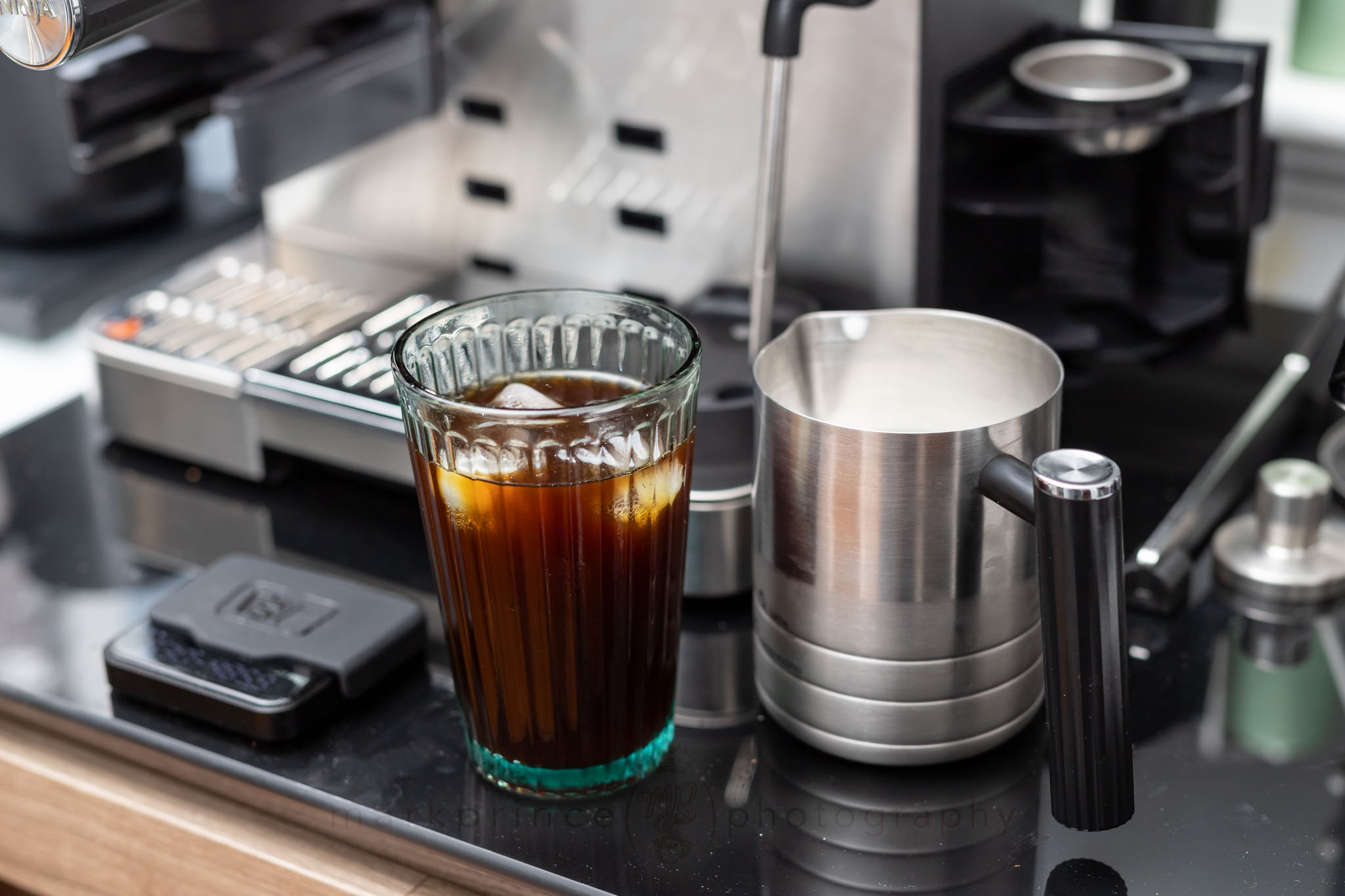
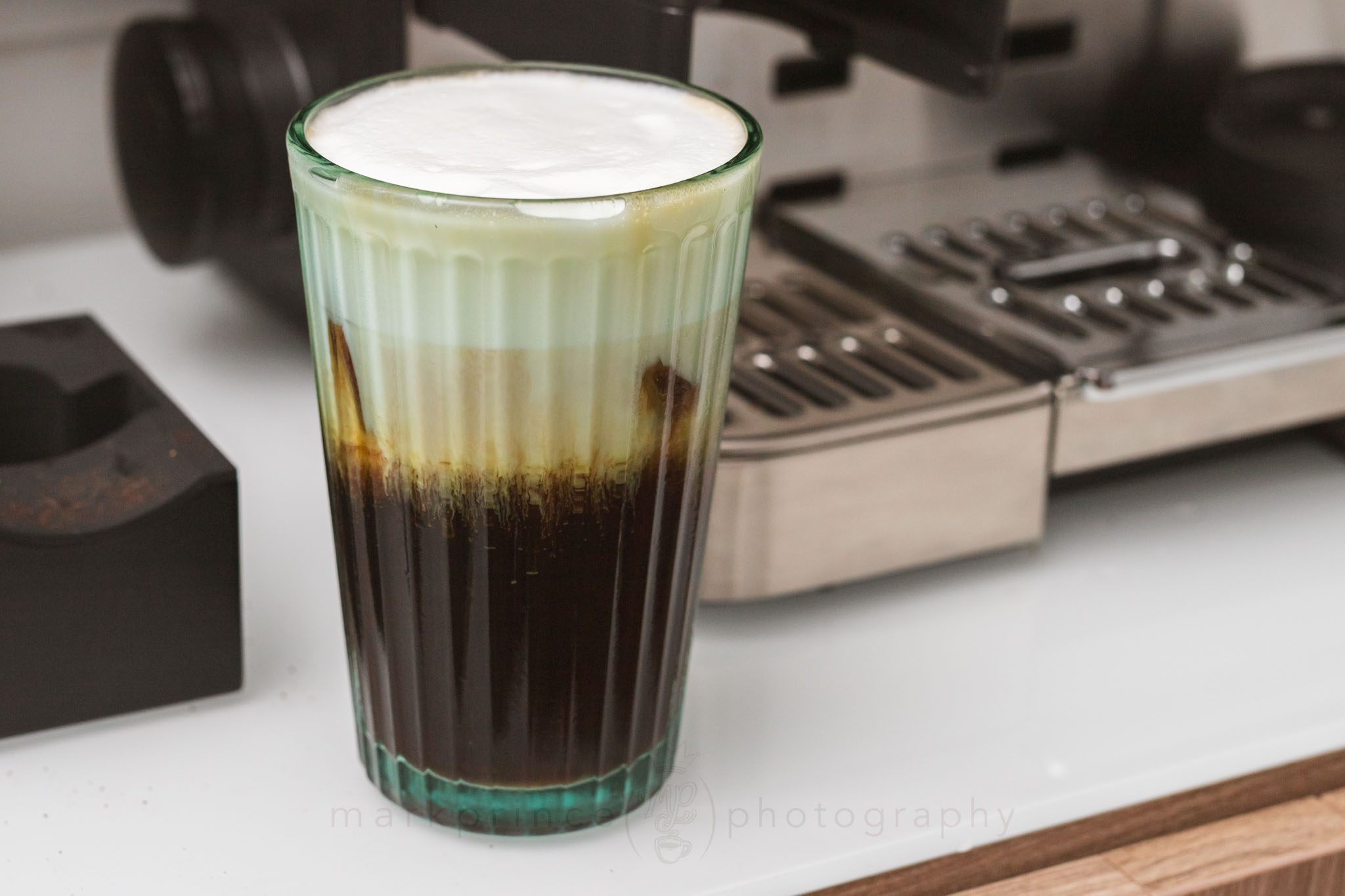
Personally, I am on Team “Cold Brew.” This mode uses reservoir-temperature water and slow pulses to extract coffee without heat. The result is smooth, low-acid, and naturally sweet. A CoffeeGeek hack that other reviewers missed: fill your water tank with ice water before running this mode. It drops the extraction temp even further and makes for a genuinely excellent cold cup.
Oh, did I mention how much I came to absolutely love the machine’s cold froth mode? I literally built new drinks around the fact that this machine produces an icey frothed milk. Even boozy drinks with Kahlua and Baileys. No other machine we’ve tested and used can produce this kind of ice cold, densely foamed milk. Add some sugar to the milk before spinning it up and it is like pourable whipped cream.
The Overall Good and Bad
After months of testing in the CoffeeGeek Lab, we have a clear picture of where this machine leads the class, and stumbles. It is easily the most feature-rich machine under $600 we have ever tested, but that ambition comes with some distinct quirks. We’ve covered most of this already, but here is the concise wrapup of our long-term findings.
The Bad
-
The Sonic Assault
There is no getting around it, this machine is loud. The initial phase of milk steaming produces a high-pitched screech that is genuinely unpleasant. It settles down, but early mornings require a closed kitchen door.
-
Fragile Dosing Collar
This is a major failure point. The plastic dosing funnel, which is mandatory for the machine to operate, feels brittle. We have seen widespread reports of the mounting tabs cracking or snapping off completely after a few months of daily use. Treat this part like glass, or be prepared to hunt for an aftermarket aluminum replacement.
-
Water Consumption
The Luxe Café is incredibly thirsty. Between the pre-infusions, the active heating management, and the aggressive auto-purging of the steam wand, you will be refilling the 2L tank constantly.
-
The Americano Omission
On the US and Canadian model (ES601), the lack of a dedicated hot water dispenser is a baffling miss. You are forced to use a kettle or run blank shots to dilute your espresso, which feels like a step backward for a "do-it-all" station.
-
Messy Pucks
When using the "Rich" or "Classic" filter coffee modes, the lack of a solenoid valve release means the coffee pucks are soupy and wet, requiring a rinse rather than a simple knock to clean.
The Good
-
Genuine Innovation
The "Cold Brew" mode is not a gimmick. Using low-pressure, cool-temp pulses creates a beverage that actually tastes like cold brew, distinct from iced coffee.
-
Cold Froth Versatility
This feature is entirely unique to the Luxe Café line. By adding a bit of sugar to the milk, you can create an instant "whipped cream" topping perfect for capping off cold brew drinks or even elevating your evening cocktails.
-
Workflow Magic
The "Queue Milk" feature is a legitimate game-changer for home workflow. Being able to stack the espresso and milk commands and walk away makes the morning routine significantly smoother.
-
Shot Quality
For a machine that controls the dose and ratio for you, the espresso is surprisingly consistently good. It hits that syrupy, balanced sweet spot more often than not, especially with the 1:2.5 ratio.
-
Near Instant On
The thermoblock system is efficient. The zero-wait time from power-on to brewing is a massive perk compared to traditional boilers.
CoffeeGeek Lab vs. The Internet
We also need to address some reliability issues reported online that we simply did not experience. A common complaint on Reddit is “Grinder Drift,” where the machine eventually forces the user to the finest setting (1) to get a good shot. In our testing of hundreds of shots, our grinder setting remained stable between 5 and 7.
Similarly, we never encountered the dreaded “Add Beans” error loop. We suspect this is because we perform a deep clean of the hopper and sensor area every few weeks. If you treat this machine like a precision tool and keep it clean, it seems to behave like one. If you treat it like a toaster, you might run into trouble.
Subscribe to
Coffee Pulse
Join the 12,850 other coffee lovers who receive CoffeeGeek's premier newsletter. Each issue dives deep into one coffee or espresso based subject. Subscribing is free, and your personal information is never shared.
By submitting this form, you are consenting to receive marketing emails from: CoffeeGeek. You can revoke your consent to receive emails at any time by using the SafeUnsubscribe® link, found at the bottom of every email. Emails are serviced by Constant Contact

Support CoffeeGeek
If you enjoy and learn from this resource, please consider making a one time or recurring donation to help support our work and fund purchases for future reviews.
Breville Barista Express (BES870XL)
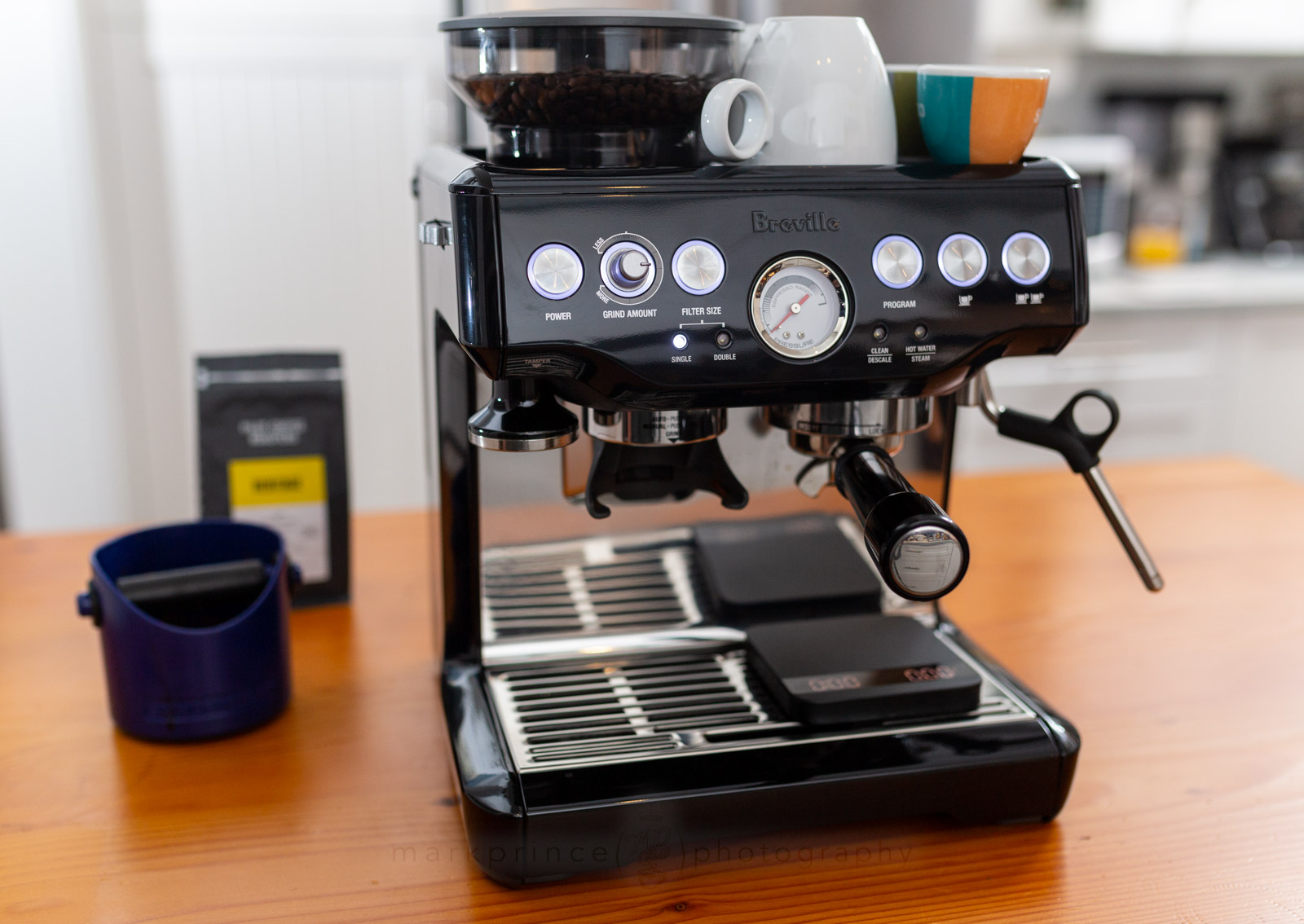
This is the machine the Ninja is clearly aiming to dethrone, and why not: The Breville Barista Express (approx $999 CAD / $699 USD) is the world’s best selling espresso machine. The Barista Express feels more “premium” with its stainless steel skin, visible pressure gauge, and uses the standard 54mm accessory ecosystem, meaning you can easily buy upgraded baskets and tampers. It is quieter and feels more like a traditional, analog machine that rewards skill development.
However, the Ninja destroys it on features. The Ninja has Cold Brew, Cold Foam, and a more “hands-off” milk workflow with the “Queue Milk” function. The Breville requires you to manually steam the milk; you have to hold the pitcher and learn the technique yourself. The Breville’s grinder is also older technology with larger grind and timer steps between settings, whereas the Ninja’s guidance system actively helps you dial in.
If you want to learn espresso as a craft and enjoy the manual ritual, buy the Breville. If you want a drink with zero fuss, modern cold drink options, and more variety, the Ninja wins on value and versatility.
De’Longhi La Specialista Arte
Priced similarly to the Ninja, the De’Longhi La Specialista is a much more manual experience. It lacks the sophisticated “assist” features of the Ninja and certainly lacks the Cold Brew tech. The De’Longhi requires more user input for tamping and steaming. While it looks a bit more “classic” on the counter, the Ninja feels a generation ahead in terms of software and user guidance. The De’Longhi is for the person who wants to tinker; the Ninja is for the person who wants the result.
Gaggia Classic Evo Pro + Budget Grinder
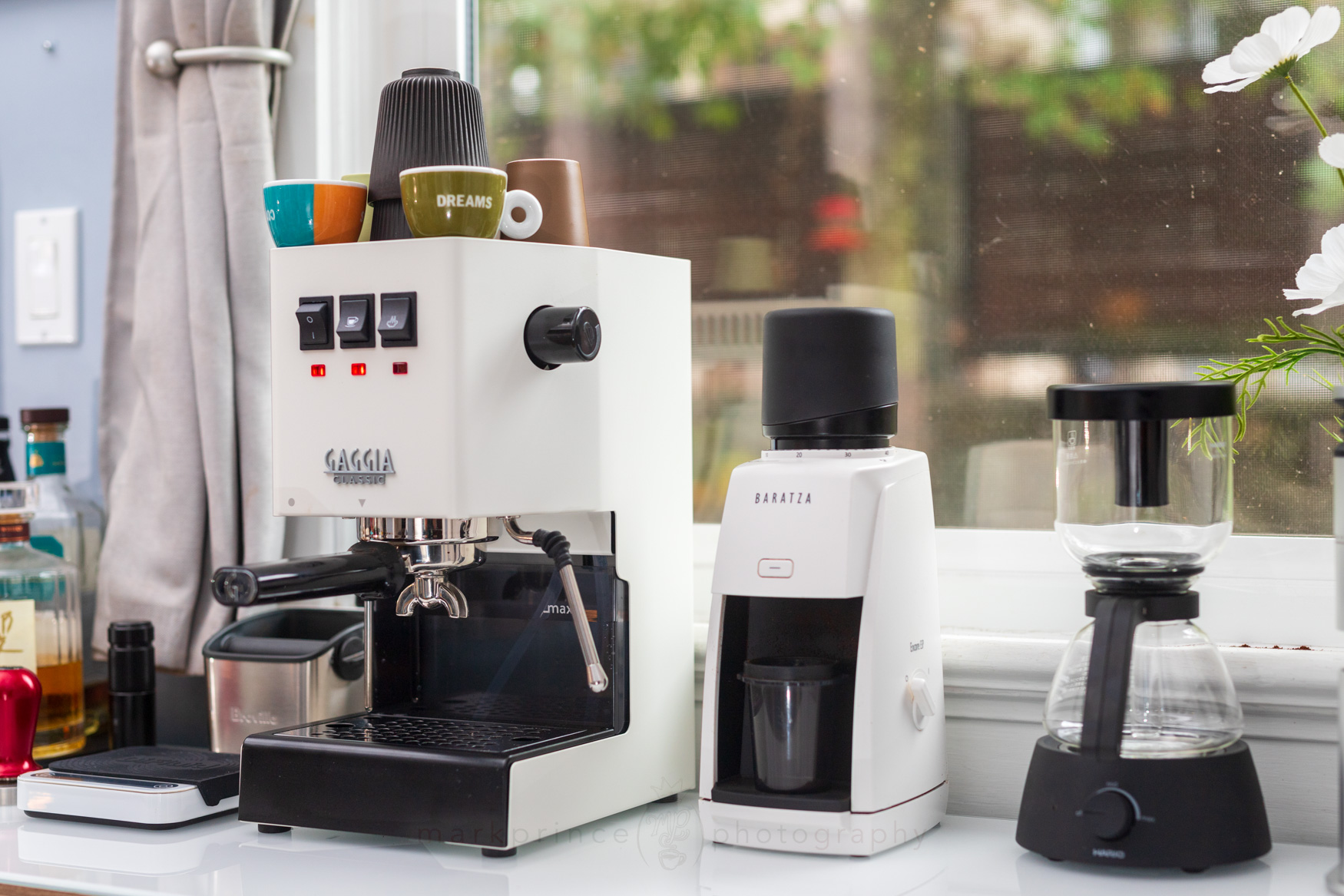
For the same $550 spend, you could buy a Gaggia Classic and a hand grinder, or a cheap electric one. That setup will last you 20 years and is fully repairable. The Ninja is an appliance that might last 5-7 years with occasional maintenance. The Gaggia makes better espresso if you have the skills to temperature surf and mod it. The Ninja makes better espresso if you don’t have those skills. It is a trade-off of longevity vs. convenience. The Ninja also offers milk frothing that is arguably easier for a beginner than the Gaggia’s single-hole wand.
Ninja Luxe Café Pro (ES701)
The stiffest competition this machine faces comes directly from its own sibling. The “Pro” model typically costs about $150 more, and honestly, it fixes our biggest gripe with the Premier model because it finally includes hot water functionality. It can dispense hot water and even has an “Auto Americano” feature, though the implementation is a bit janky compared to a dedicated spout. It also adds an integrated “Smart Tamping System” lever on the left side.
While we usually prefer manual tools, the lever fits the target market for this machine perfectly as it simplifies the workflow even further for beginners. Throw in the fact that the Luxe Café Pro includes a single shot basket (missing on the Premier) alongside the double and quad, and the Pro is likely worth the extra cash if you are a daily Americano drinker or want a less involved (yet more accurate) tamping system.
Comparison Chart
| Feature | Ninja Luxe Café Premier | Ninja Luxe Café Pro | Breville Barista Express | De'Longhi La Specialista Arte | Gaggia Classic Evo Pro |
|---|---|---|---|---|---|
| Model Number | ES601 | ES701 | BES870XL | EC9155 | N/A |
| MSRP (USD) | $549 | $699 | $699 | $699 | $499 (Machine Only) |
| Brew Modes | Espresso, Drip Coffee, Cold Brew, Quad Shot | Espresso, Drip Coffee, Cold Brew, Quad, Americano | Espresso, Hot Water (Manual Americano) | Espresso, Americano, Hot Water | Espresso Only |
| Integrated Grinder | Yes | Yes | Yes | Yes | No (Requires Separate Purchase) |
| Portafilter Size | 53mm | 53mm | 54mm | 51mm | 58mm (Commercial Standard) |
| Warm-Up Time | ~30 Seconds | ~30 Seconds | ~3 Minutes | < 30 Seconds | ~5 Minutes |
| Tamping Workflow | Manual "Assisted" (Spring-Loaded) | Integrated "Smart" Lever | Manual (Tamper Included) | Manual (Tamper Included) | Manual (Tamper Included) |
| Milk Frothing | Hands-Free (Auto Steam + Whisk) | Hands-Free (Auto Steam + Whisk) | Manual Steam Wand | Manual Steam Wand | Manual Steam Wand |
| Cold Brew Mode | Yes (Low Temp & Pressure) | Yes (Low Temp & Pressure) | No | No* | No |
| Hot Water Spout | No | Yes | Yes | Yes | Yes (Via Steam Wand) |
| Baskets Included | Double, Quad (Non-Pressurized) | Single, Double, Quad (Non-Pressurized) | Single & Double (Pressurized + Standard) | Single & Double (Pressurized) | Single, Double (Pressurized + Standard) |
| Pressure Gauge | Digital (On Screen) | Digital (On Screen) | Analog Pressure Gauge | Analog Pressure Gauge | None |
| Best For... | Convenience & Value | All-in-One Feature Seekers | Learning the Craft | Tinkering / Manual Feel | Longevity & Repairability |
Subscribe to
Coffee Pulse
Join the 12,850 other coffee lovers who receive CoffeeGeek's premier newsletter. Each issue dives deep into one coffee or espresso based subject. Subscribing is free, and your personal information is never shared.
By submitting this form, you are consenting to receive marketing emails from: CoffeeGeek. You can revoke your consent to receive emails at any time by using the SafeUnsubscribe® link, found at the bottom of every email. Emails are serviced by Constant Contact

Support CoffeeGeek
If you enjoy and learn from this resource, please consider making a one time or recurring donation to help support our work and fund purchases for future reviews.
The Ninja Luxe Café Premier (ES601) is the machine that forced me to eat my words. I started this review with a “don’t prejudge” note on my whiteboard, fully expecting a plastic toy that made pressurized, fake espresso. I was wrong. This is a legitimate brewing tool that successfully bridges the gap between a kitchen appliance and a hobbyist espresso setup.
It is not perfect. It is loud, it wastes water like a leaky faucet, and the lack of a hot water dispenser on this specific model is a frustrating omission. But we cannot argue with the results in the cup. The espresso is syrupy and properly extracted. The “Queue Milk” workflow is a morning lifesaver. The Cold Brew mode is a genuine innovation that actually works.
For $549, there is simply nothing else on the market that offers this level of technology and cup quality. That is why we are awarding it a very high score of 88.5 out of 100. This score secures the machine a CoffeeGeek Best in Class award for entry-level espresso systems. It redefines what an appliance in this category can be.
The “Pro” Dilemma
However, there is a plot twist. We have also been testing the Ninja Luxe Café Pro (ES701), and spoiler alert: it is going to score even higher. The Pro model fixes our biggest complaints by adding a hot water dispenser, an Americano mode, and a single-shot basket. It also includes an automated tamping lever that simplifies the workflow even further.
So here is the bottom line. If your budget is strictly capped at $550, buy the Premier (ES601). It is the absolute best bang for your buck in the coffee world right now. You will love it.
But, if you can stretch your budget by another $150 to reach the $699 price point for the Pro, wait for that machine. That extra cash buys you the “complete” experience that the Premier just barely misses.
-
9.0DesignA busy but generally logical interface. The magnetic storage and hidden compartments are brilliant, elevating it beyond a typical appliance.
-
9.5Usability“Queue Milk” is magic. The workflow is incredibly smooth, and automated steps remove almost all frustration for those new to espresso.
-
9.0FeaturesCold Brew, Cold Foam, Auto-Purge, and varied espresso ratios. It packs more tech than machines costing three times as much. Would score 10 if it had hot water ability.
-
8.5PerformanceSolid 1:2.5 espresso ratios and genuine Cold Brew innovation. The milk texture is good, though the process remains loud.
-
10Value vs. CostUnbeatable. You cannot find this feature set, build quality, and performance for $549 anywhere else. Period.
-
8.5Quality of BuildUnexpectedly dense and heavy (9.5kg). The accessories (tamper, baskets) are premium quality, feeling far better than budget standard.
-
8.0Service / WarrantyStandard warranty, but the wide availability of cheap spare parts (baskets, reservoirs) suggests a machine meant to be repaired.
-
9.5Included in the BoxThe “Starter Kit” is complete. Two baskets, a heavy tamper, cleaning kit, and specific milk jug. Nothing else to buy.
-
8.0Resale ValueHigh demand and unique features likely mean this will hold value better than typical kitchen appliances.
-
8.5OverallThe Ninja Luxe Café Premier is a category disruptor. It is not perfect as the noise and water usage are real issues, but it successfully democratizes specialty coffee features that were previously out of reach for this price point. It does exactly what it promises to do.
Where to Buy
Subscribe to
Coffee Pulse
Join the 12,850 other coffee lovers who receive CoffeeGeek's premier newsletter. Each issue dives deep into one coffee or espresso based subject. Subscribing is free, and your personal information is never shared.
By submitting this form, you are consenting to receive marketing emails from: CoffeeGeek. You can revoke your consent to receive emails at any time by using the SafeUnsubscribe® link, found at the bottom of every email. Emails are serviced by Constant Contact