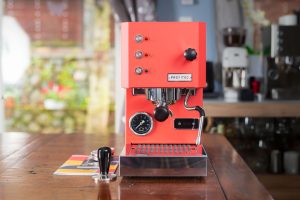



Out of the BoxBarista Touch Impress
The Barista Touch Impress arrives in a substantial, glossy retail box. Inside, however, the machine is secured by large, fitted blocks of styrofoam. This is somewhat disappointing, as Breville has already demonstrated a much better approach with its newest releases. Their latest machines, like the Oracle Jet, now ship in plain brown boxes, using fully recyclable, form-moulded cardboard inserts to protect the machine during transit. It’s an eco-friendly philosophy we hope to see across their entire product line.
Once unboxed and on the counter, the machine has a significant presence. Its aesthetic borrows the softer, curving lines from the more expensive Oracle Touch, distinguishing it from the angular, utilitarian form of the classic Barista Express, a design philosophy Breville has continued with its latest flagship, the Oracle Jet. The softer curves are not just for looks; they also make the machine easier to wipe down compared to the sharper corners of the Express. The fingerprint-resistant brushed stainless steel gives it a solid, high-end appliance feel.
A tour from top to bottom reveals a series of practical design choices. The bean hopper is generously proportioned with a wider diameter than previous Barista models, allowing it to comfortably hold a full 340 gram (12 ounce) bag of coffee. A twist-to-lock mechanism seals the hopper’s base for mess-free bean swaps.
Hidden beneath this hopper is a significant internal hardware upgrade: a set of Baratza’s M2 conical burrs, precision-milled by the European firm Etzinger. This is a notable component, as it is the same burr set found in dedicated grinders like the Baratza Encore ESP Pro. For the user, this means the potential for a more consistent grind particle size, a key factor in improving the taste of the final espresso shot.
At the rear of the unit, the 2 litre (68 fluid ounce) water reservoir is designed for easy access. It can be filled in place or removed entirely using its sturdy handle. It incorporates both a magnetized low-water sensor and Breville’s integrated charcoal filter system. This filtration benefits flavour and machine longevity by reducing scale buildup.
The front of the machine is starkly minimal. Aside from a single, backlit power button, all user interactions are channelled through the large, vibrant colour touchscreen. This approach looks clean, but it also means every function, even a simple group flush, requires interacting with the screen, which can be less immediate than a physical button.
Below this screen is the main workspace, organized into three zones: the integrated grinding and tamping station on the left, the 54mm grouphead in the centre, and the automatic steam wand and hot water tap on the right.
The star of the left side is the “Impress” tamping system, activated by a large, mechanical side lever that provides satisfying, tactile feedback. On the right, the steam wand itself has a more robust, multi-part construction that feels more premium than those on other Barista line machines. The high-polish stainless steel backsplash looks sharp but is a fingerprint and splash magnet that requires frequent cleaning.
It might sound odd to positive-focus on a drip tray, but I have to give Breville credit here. I’ve handled the trays on nearly $10,000 prosumer machines that feel like flimsy, cheap afterthoughts (yeah, looking at you La Marzocco). By contrast, this one is robust and exceptionally well-finished. Pulling the entire unit out reveals the hidden accessory storage inside. It’s a great spot for stashing less-used items like the backflush disk, single basket, or cleaning tablets.
The included accessory kit is comprehensive. You receive four filter baskets (two single-wall for fresh coffee, two double-wall for pre-ground), a quality 480 ml (16 ounce) stainless steel milk pitcher, the water filter assembly, and a full suite of cleaning supplies. A standalone tamper is notably absent, as its services have been made null and void by the machine’s internal tamping system. Weirdly, the machine does come with Breville’s Razor tool, which seems a bit redundant. And the multitool for cleaning the steam wand doesn’t actually fit the new steam wand on this machine (for removal of the tip, at least).
Dimensionally, the unit measures 36 cm wide, 34 cm deep, and 41.5 cm tall (14.2 x 13.4 x 16.3 inches). It feels planted and secure on the counter, thanks to excellent high-grip rubber feet that prevent it from sliding when locking in the portafilter.
Subscribe to
Coffee Pulse
Join the 12,850 other coffee lovers who receive CoffeeGeek's premier newsletter. Each issue dives deep into one coffee or espresso based subject. Subscribing is free, and your personal information is never shared.
By submitting this form, you are consenting to receive marketing emails from: CoffeeGeek. You can revoke your consent to receive emails at any time by using the SafeUnsubscribe® link, found at the bottom of every email. Emails are serviced by Constant Contact

Support CoffeeGeek
If you enjoy and learn from this resource, please consider making a one time or recurring donation to help support our work and fund purchases for future reviews.

Using TheBarista Touch Impress
Breville clearly wants you to get started on the Touch Impress without ever opening the manual, and to their credit, they make that easy. The moment you press the power button, the touchscreen lights up with a soft chime and begins guiding you through setup like a friendly assistant. It feels more like setting up a phone or tablet than an espresso machine, but it works.
The machine starts by asking a few practical questions. It wants to know what kind of milk you use, so it can adjust its frothing routine for dairy, oat, soy, or almond milk. Then it has you test your water hardness with a small strip and enter the result. From that, it automatically sets up reminders for descaling, which helps protect the machine from scale buildup and keeps the coffee tasting consistent. It is clear this product was designed for people who want good results without thinking about maintenance.
Part of the setup process is crafting your first drinks with the machine: a standard espresso shot, and a milk based drink. The tutorials hold your hand here delicately, and will run you through grinder adjustments and the like, explaining things as it goes along. Once the tutorials are done, the machine is ready for daily use.
Once setup is done, you have a wide array of drink builds to choose from in your daily use. Pick a beverage from the touchscreen, lock the portafilter into the cradle, and tap the grind icon. The machine doses automatically, and when the grinding stops, pull the large side lever. It feels solid and mechanical, almost like pulling a gear shift. The Impress tamping system presses the coffee with even pressure and finishes with a small polishing twist (it’s more marketing gimmick than actual effectiveness), leaving a clean, level puck. For anyone who has tamped unevenly in the past, this part is genuinely satisfying.
The smart dosing feature looks for a target puck height rather than a specific weight. If the height is too low, the screen prompts you to grind a little more. Once the correct level is reached, the machine remembers that dose for next time. It is a simple but clever way to help beginners achieve consistency without using a separate scale.
The grind setting itself is still adjusted manually using the dial on the side, but the machine gives feedback after each shot. It times the extraction and then suggests whether to go finer or coarser next time. It is not magic, but it saves new users from guessing blindly.
Breville advertises its ThermoJet heating system as ready in three seconds, and technically that is true. The water is hot almost instantly. The problem is that the grouphead and portafilter are still cold, and if you brew right away, the shot will come out sour and under-extracted. The solution is to run a blank shot first to preheat the metal parts, which works fine, but the process is slower than it should be. You have to dig through the drink menu on the touchscreen every time to do this. A simple flush grouphead button on the main screen would make a big difference.
Once properly preheated, the espresso from the Touch Impress is quite good (bordering on world class at times), but its real strength is its relentless consistency. After dialing it in, I was pulling nearly identical shots time after time using the timing and yield weights from CoffeeGeek’s standard espresso machine test parameters (we could not set the initial dose weight; relying instead on the machine’s preset volumes). FYI, that formula is 18.5g in, 45g yield, in around 25-30 seconds (without preinfusion) or 35-40 seconds with preinfusion.
Here’s the process in action.
For most people, however, the real star of the show will be the Auto MilQ system. You’re essentially outsourcing the tricky skill of milk texturing and accurate temperatures to the machine. You just fill the pitcher, place it on the sensor, and tell the machine what you’re making. The result is a fine, pourable microfoam that it handles well even with non-dairy milks. For anyone buying this machine primarily for lattes and cappuccinos, this is arguably the feature that seals the deal.
The BBTI also lets you queue up the entire process in one go. Prep your portafilter, fill the milk pitcher, and place both in their respective places in the machine. Hit the shot button on screen, and also tap the steam milk icon right after. The machine will pull the shot, then immediately transition the Thermojet to steam mode, and automatically start steaming. You can come back about a minute later to find a nicely pulled shot and a pitcher of microfrothed milk waiting for your always-improving latte art skills. It even finishes by politely reminding you to wipe the steam wand, so it can even handle the nagging for you.
Unfortunately, the hot water function is deeply frustrating for Americano drinkers. One has to question if the Breville engineers even drink Americanos or Mistos. The automated settings are nonsensical for traditional recipes; the smallest preset dispenses 130 ml of water (a double shot needs a max of 90 ml for an americano), and you cannot stop it early. To add insult to injury, the water is a tepid 63°C (147°F) in repeated measurements. It’s a baffling design flaw.
What makes this flaw worse is that the Touch Impress cannot receive firmware updates. There is no Wi-Fi connection or USB port for new software. Whatever version the machine ships with is the one you will have for its entire life. For a product that depends so much on software, this feels like a huge swing and a miss.
Despite these annoyances, using the Touch Impress day to day is decently enjoyable. It is fast, intuitive, and clean to operate. You can stumble into the kitchen half-awake, tap a few icons, and end up with an espresso or cappuccino that looks and tastes a thousand percent better than what you would get from a capsule machine. Heck, it’ll probably be better than most cafés these days.
It is not made for people who want to learn the craft of espresso, but for anyone who wants café-level drinks with minimal effort, it comes surprisingly close.
Barista Touch ImpressCompeting Products
The Barista Touch Impress sits in a crowded field of machines that aim to blend traditional espresso mechanics with heavy digital assistance. They attempt to deliver a full bean-to-cup experience without requiring separate components like a standalone grinder, but this integration often comes with its own trade-offs. Its most direct competitors are found both within Breville’s own lineup and from other established brands.
Breville Barista Express Impress
Its closest and most obvious point of comparison is its direct sibling, the Breville Barista Express Impress. This machine is the analog, more hands-on version of the same core concept. It features the same “Impress” intelligent dosing and assisted tamping system. However, the user experience diverges sharply from that point forward.
The Express Impress uses an older, slower-to-heat thermocoil system. While slower, it has the advantage of heating the entire machine, including the grouphead, for better temperature stability on the first shot. This is unlike the Touch Impress, whose fast Thermojet only heats the water, leaving the brewing components cold. The Express Impress is also controlled by an array of physical buttons and dials. It features a prominent pressure gauge, which provides visual feedback that can be useful for users interested in learning about extraction. The process of manually steaming milk, while requiring practice, also offers a higher ceiling for control over texturing for latte art. For many, the lower price point ($799.95 USD / $1,149.95 CAD) will be a deciding factor. (nb, as of this writing (Oct 15, 2025), it is on sale in Canada for just $900, making it an extraordinary value)
Breville Oracle Jet
Moving up the Breville hierarchy is the new Breville Oracle Jet. Priced at $2,000 USD ($2,999CAD, currently on sale for $2400CAD), it is positioned as a more advanced machine. For the $500 price difference over the Barista Touch Impress, the Jet includes several key hardware and software differences.
The Oracle Jet is built around a commercial-style 58mm portafilter and grouphead, allowing for larger, more traditional espresso doses up to 22g. Its tamping system is fully automated and internal, requiring no lever pulling from the user. It comes with a very nice and upgraded knock box, and the Jet’s completely new grinder has stepless adjustments for more precise control.
Crucially, the Jet also features a dual Thermojet heating system, with one dedicated to rapidly heating the grouphead, directly addressing the Touch Impress’s issue with cold-start temperature stability. Most importantly, the Oracle Jet is the first Breville machine with internet connectivity, allowing for Over-the-Air (OTA) firmware updates, a massive advantage.
While both machines feature the same automated MilQ system, the Jet’s superior hardware and updatable software make it a more advanced machine. At full retail price, the Oracle Jet’s upgrades may justify the extra $500 investment. However, the decision becomes much more difficult when the Barista Touch Impress is found on sale, as its value proposition increases significantly.
De’Longhi La Specialista Maestro
Outside the Breville ecosystem, a strong competitor is the De’Longhi La Specialista Maestro, which competes at a similar price point of $1,299.95 USD (often on sale for $1000), and $1899.99 in Canada (often on sale for $1500). This machine targets the same user with a different technological approach. It also integrates a grinder with an assisted “Smart Tamping Station” to ensure a level, consistently tamped puck without the mess of loose grounds.
It uses a dual heating system for rapid transitions between brewing and steaming and offers two separate milk systems. It has both a manual, pro-style steam wand for users who want to practice latte art and a separate, fully automatic “LatteCrema” system for one-touch convenience. This combination of features offers a flexibility that will appeal to some buyers.
Ninja Cafe Luxe Pro
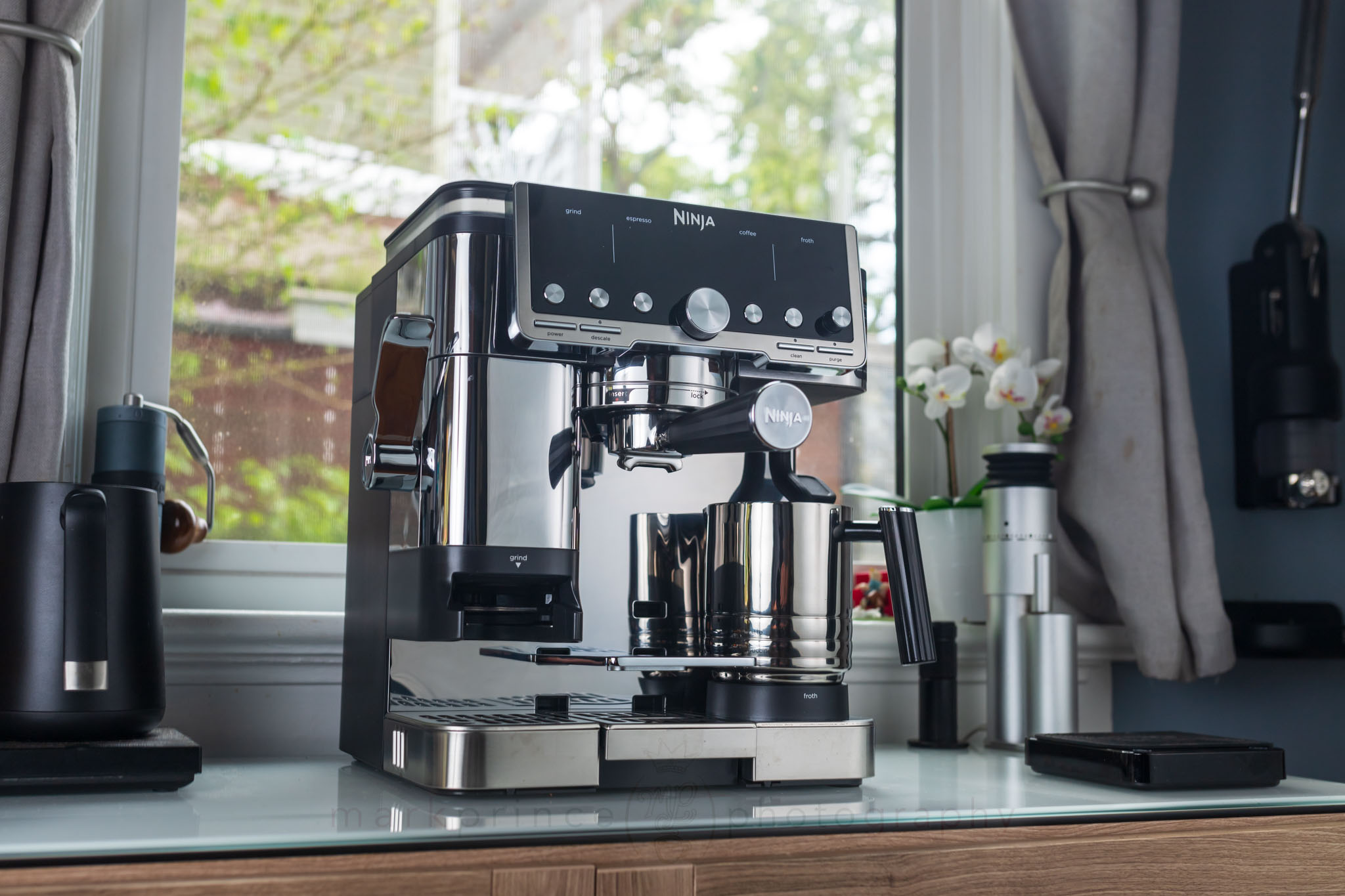
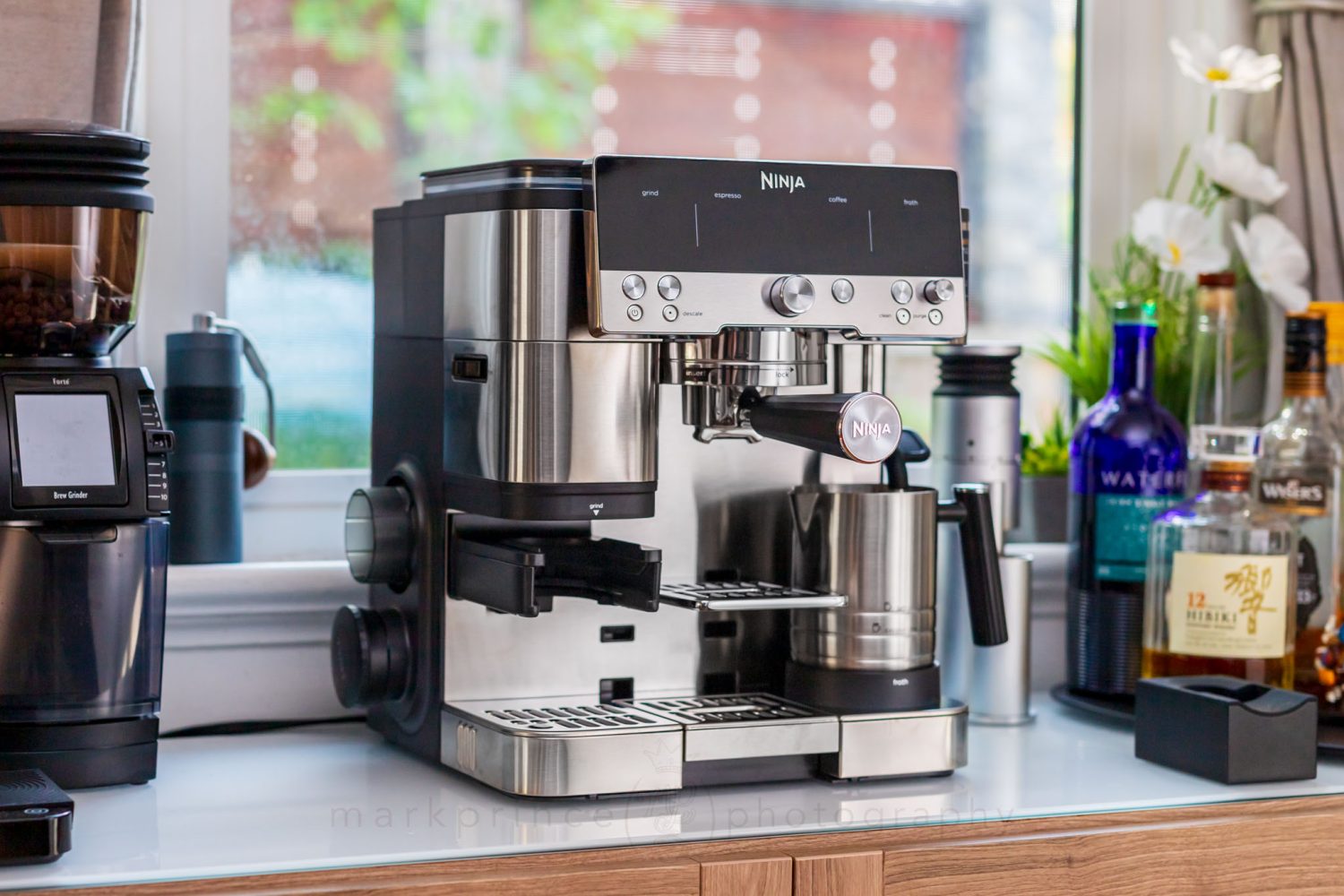
Finally, a noteworthy budget competitor is the Ninja Café Luxe Pro. Priced around $750 USD (prices are up because of the Trump Tax), and $900 Canadian (a better deal these days because of the USA tariff nonsense) it’s roughly half the cost of the BBTI. For that price, it also offers an integrated grinder, a lever-based tamping system, and a hands-free automated milk frother. It even includes a wider array of drink options, from ristretto and lungo to larger brewed coffees.
This feature parity is notable, but there are key trade-offs to consider. Ninja is a recent entrant into the espresso market, compared to Breville’s decades-long track record. The Ninja’s versatility is also accessed via a complex, button-driven interface, which contrasts with the single, guided touchscreen on the Barista Touch Impress. Differences in component quality, such as the BBTI’s premium Baratza burrs, also likely account for the price gap.
At full retail, the price difference is stark. However, the Barista Touch Impress is occasionally on sale, sometimes as low as $1000USD. This narrows the gap considerably, shifting the decision from one of pure budget to a choice between the BBTI’s user experience and the Ninja’s button-based functionality.

Support CoffeeGeek
If you enjoy and learn from this resource, please consider making a one time or recurring donation to help support our work and fund purchases for future reviews.
ConclusionBarista Touch Impress
After a few weeks with the BBTI, a clear picture is emerging. Let’s be clear: this machine isn’t a tool for the aspiring artist. It’s a high-end appliance for those who want a great result without serving an apprenticeship.
If you want to graduate from capsules for better espresso but are intimidated by the learning curve of a traditional setup, this machine is for you. It delivers on its core promise: providing repeatable high-grade espresso shots and a high level of automated milk frothing, especially for non-dairy milks.
But this convenience comes at a price, and not just the monetary one. In exchange for the automation, you give up a lot of granular control. This isn’t just about tweaking for fun; it’s about the ability to adapt to different beans or correct a shot that’s pulling too fast or slow, a capability the machine deliberately abstracts from the user. You also have to live with its quirks, like the mandatory pre-heating and the poorly designed hot water function.
At its full retail price of $1,499.95 USD ($2,149.95 CAD), its value proposition is complicated. For $500 more, Breville’s own Oracle Jet offers significant upgrades like a 58mm portafilter and OTA firmware updates. Meanwhile, competitors like the Ninja Café Luxe Pro offer a surprisingly similar automated feature set for roughly half the price.
The value of the Barista Touch Impress hinges heavily on the times Breville puts it on sale. It is occasionally discounted, sometimes dropping as low as $1,000 USD retail. At that price, it becomes a much more compelling middle ground, offering a more premium build and user interface than the Ninja without the steep cost of the Oracle Jet.
This is our First Look. The real test is how this complex piece of technology holds up over the long haul. Will the software remain snappy? Will the automated systems prove reliable? We’ll be putting this machine through a comprehensive, long-term review to answer those questions and more.
In the meantime, if you own one or are on the fence, we want to hear from you. What has your experience been? Let us know in the comments below.
We use affiliate links to a) Amazon, and b) manufacturers only. Any links to vendors (including CoffeeGeek Sponsors) are not income generating links. Further details about our commission and affiliate link policies can be found on our Terms and Conditions Page. The use of any affiliate links have no effect on our editorial policy or review objectivity.
Subscribe to
Coffee Pulse
Join the 12,850 other coffee lovers who receive CoffeeGeek's premier newsletter. Each issue dives deep into one coffee or espresso based subject. Subscribing is free, and your personal information is never shared.
By submitting this form, you are consenting to receive marketing emails from: CoffeeGeek. You can revoke your consent to receive emails at any time by using the SafeUnsubscribe® link, found at the bottom of every email. Emails are serviced by Constant Contact
Mark has certified as a Canadian, USA, and World Barista Championship Judge in both sensory and technical fields, as well as working as an instructor in coffee and espresso training. He started CoffeeGeek in 2001.

- Mark Prince
- Mark Prince
- Mark Prince


3 Responses
Hi Mark, thanks for an interesting article. I have been eying BBTI for a while and nearly pressed the button when it became a $1760 special here in Canada. What stopped me (for now at least) was what you mention about grouphead requiring a hot rinse/heating up procedure. This sounds like a silly omission on otherwise well thought out/designed machine. Do you think it’s likely that Breville will realize this shortcoming and fix it in the (soon?) update of this model? Another point which I don’t remember from your review is the temperature adjustment – to play with (reduce) the bitter/sour taste of different beans. dDoes it have it?
Thanks again,
Marian
Excellent rundown of this machine, one I’ve had my eye on. Thanks for being such a reliable source of objective coffee and espresso informations. 😊
Thank you for this and your other first look reviews, including your review for the Ninja Cafe Luxe Pro. One question: can you confirm that this machine does not
Brew larger cups of coffee like the Ninja Cafe Luxe Pro. I don’t see a machine outside the Ninja that can do this.